

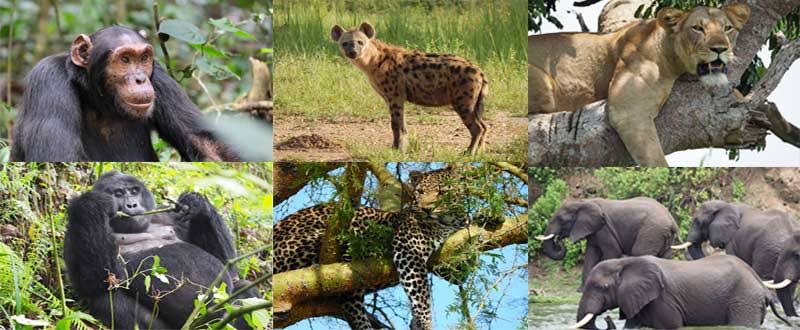
Seven days may not seem like enough time to explore Uganda, but with the right route, one week can deliver an extraordinary combination of primates, wildlife, landscapes and classic safari experiences. The secret is not trying to visit everything.
Uganda has numerous national parks and wildlife areas spread across the country. Attempting to include Murchison Falls, Kibale, Queen Elizabeth, Bwindi, Lake Mburo, the Rwenzoris and the source of the Nile in a single week would create more time inside a vehicle than actually experiencing the destinations.
Introduction
For most first-time visitors interested in Uganda’s signature wildlife, the strongest 7 days in Uganda itinerary combines three areas: Kibale National Park for chimpanzees, Queen Elizabeth National Park for wildlife and a boat safari, and Bwindi Impenetrable National Park for mountain gorillas. It is an efficient southwestern Uganda route that combines three completely different wildlife experiences without excessive backtracking.
Here is how we would structure it.
Why This Route Works for a One-Week Uganda Safari
A good seven-day itinerary needs variety without becoming rushed. Kibale, Queen Elizabeth and Bwindi complement each other exceptionally well. In Kibale, you enter tropical forest in search of chimpanzees. At Queen Elizabeth, the landscape opens into savannah, channels, crater areas and wildlife country. Bwindi then returns you to rainforest—but this time for mountain gorillas.
Within one week you can therefore experience two great ape encounters, traditional game viewing and one of Uganda’s best-known boat safari environments. The destinations also connect naturally by road. This makes the itinerary much more practical than jumping between distant corners of Uganda.
Day 1: Entebbe or Kampala to Kibale National Park
Your 7 days in Uganda itinerary begins with a journey west toward Kibale National Park. Most travelers start from Entebbe, where Uganda’s principal international airport is located, or Kampala. The drive introduces you to rural Uganda. As you leave the busier central region, the scenery gradually changes. Roadside communities, farms, banana plantations and rolling landscapes provide a first glimpse of life outside the capital. Depending on your schedule and preferred routing, you may stop for lunch along the way before continuing toward the Fort Portal and Kibale region. The objective is to arrive near Kibale with enough time to relax before the following morning’s chimpanzee trek.
Overnight
Choose accommodation near Kibale National Park or the Kanyanchu area to reduce unnecessary driving on trekking morning. A range of budget, mid-range and luxury lodges is available around the forest.
Day 2: Chimpanzee Trekking in Kibale and Transfer to Queen Elizabeth
Wake early and prepare for your first major wildlife experience. Chimpanzee trekking begins with registration and a ranger briefing. You then enter the forest with guides and begin searching for a habituated chimpanzee community. Sometimes chimpanzees can be heard before they are seen. Pant-hoots echo through the forest. Branches move. Calls from one group may be answered by individuals elsewhere. Unlike gorillas, chimpanzees can be extremely active. They may feed high in trees and later descend to the forest floor. You may need to move quickly at certain moments to maintain a good viewing position. Once the experience is complete, return from the forest and continue toward Queen Elizabeth National Park. This transition is one of the pleasures of the itinerary. In a matter of hours, the environment changes from dense chimpanzee forest to open wildlife country. Depending on arrival time, you may enjoy an evening drive or simply transfer to your lodge overlooking the park landscape.
Day 3: Kasenyi Game Drive and Kazinga Channel Boat Safari
Day three introduces classic African safari wildlife. Start early with a game drive in the Kasenyi Plains or another productive game-viewing area of Queen Elizabeth National Park. Morning is an excellent time to search for wildlife while temperatures remain relatively cool. Depending on conditions and luck, animals encountered can include Uganda kob, buffalo, elephants, warthogs and several antelope species. Predators are never guaranteed, but lions are among the highlights travelers hope to encounter. A good guide reads much more than the road. They watch animal behavior. They look for fresh tracks. They listen to alarm calls. They communicate with other guides when appropriate. The search itself becomes part of the safari experience. After the morning game drive, return for lunch or relax before heading toward the Kazinga Channel.
Kazinga Channel Boat Safari
The boat safari offers a completely different perspective. Instead of searching for wildlife from a vehicle, you travel along the water and observe animals using the shoreline. Hippos are a major attraction. Buffalo may rest near the water. Elephants sometimes approach to drink. Waterbirds can be exceptionally abundant. For photographers, the boat provides opportunities to observe wildlife at eye level and with fewer obstructions than in thick vegetation. After the cruise, continue to your lodge for dinner and overnight.
Day 4: Queen Elizabeth Through Ishasha to Bwindi
This is not simply a transfer day. The route south through Queen Elizabeth National Park can take you through the Ishasha sector, an area famous for its association with tree-climbing lions. Lion sightings are never guaranteed, and the animals do not spend every day sitting conveniently in trees. That unpredictability is part of genuine wildlife viewing. Allow time for a game drive while moving through Ishasha. Even without lions, the sector can offer rewarding landscapes and wildlife. Afterward, continue toward Bwindi Impenetrable National Park. The scenery changes dramatically as you approach Uganda’s southwestern highlands. Roads curve through increasingly mountainous terrain. Cultivated hillsides rise above valleys. Dense forest eventually dominates the landscape. Your lodge should ideally be selected according to the gorilla trekking sector allocated for your permit. This detail matters. Bwindi has several trekking sectors, and accommodation should be coordinated with your trekking location rather than chosen simply because a lodge looks attractive online.
Day 5: Gorilla Trekking in Bwindi Impenetrable National Park
For many travelers, this is the day around which the entire journey has been planned. After an early breakfast, transfer to the relevant Bwindi trekking headquarters. The morning begins with registration and a ranger briefing covering gorilla behavior, forest etiquette and trekking guidelines. Visitors are then allocated into trekking groups and begin walking with ranger guides. The length and difficulty of the trek varies. Mountain gorillas move freely through the forest, so their position changes from one day to another. Some groups may be found comparatively quickly. Others may require a longer hike through steep terrain and dense vegetation. Trackers assist in locating the gorilla family. Then comes the moment most travelers remember for the rest of their lives. You see your first mountain gorilla. The encounter can feel surprisingly quiet. A silverback may sit feeding only a short distance away. A mother may carry an infant. Young gorillas may climb vegetation or play with one another. Because these are wild animals, no two encounters are identical. Follow your guide’s instructions carefully and concentrate on observing rather than trying to control the experience. After trekking, return to your lodge. Many travelers prefer to keep the remainder of the afternoon relaxed. A hot shower, good meal and time to process the experience can be more rewarding than immediately adding another activity.
Day 6: Bwindi to Lake Bunyonyi or Lake Mburo
After gorilla trekking, there are several ways to use the sixth day. One particularly relaxing choice is Lake Bunyonyi. The lake offers a dramatic contrast to the intensity of the previous day’s forest trek. Surrounded by terraced hills, its calm environment works well as a decompression stop. You can take a boat excursion, enjoy the views or simply relax at your lodge. Another option, especially for travelers who want to make progress toward Entebbe, is continuing toward Lake Mburo National Park. Lake Mburo works particularly well as a final safari stop because of its position along the southwestern route. Travelers interested in extending wildlife viewing may choose a game drive or another permitted activity depending on arrival time. Which option is better? Choose Lake Bunyonyi if relaxation and scenery are priorities. Choose Lake Mburo if you want additional wildlife and a more efficient final journey toward Kampala or Entebbe.
Day 7: Return to Entebbe
The final day completes the circuit back toward Entebbe. If travelling from Lake Mburo, the journey is considerably more manageable than driving all the way from Bwindi in a single day. The route commonly passes through central Uganda and provides opportunities for stops along the way. If your international flight departs late at night, it may be possible to connect directly with departure. However, building reasonable time buffers into the itinerary is important. Road travel can be affected by traffic and other conditions. Travelers with early flights should strongly consider an additional night in Entebbe rather than creating unnecessary pressure.
Could You Replace Kibale With Murchison Falls?
Yes, but it changes the character of the safari. A seven-day route combining Murchison Falls and Bwindi can work, but the distance between northern and southwestern Uganda creates longer driving days. Murchison is an excellent destination, particularly for travelers prioritizing large mammals, the Nile and classic game drives.
However, if your goals are gorillas, chimpanzees and savannah wildlife in only seven days, Kibale–Queen Elizabeth–Bwindi generally creates a more geographically efficient route. Murchison fits more comfortably when you have additional days.
Could You Start the Safari From Kigali?
Yes. Travelers primarily interested in gorilla trekking sometimes fly into Kigali in Rwanda and cross into southwestern Uganda. This can reduce road travel when the itinerary concentrates around Bwindi, Mgahinga and Lake Bunyonyi. However, once Kibale and Queen Elizabeth are added, the route becomes more complex. Whether Kigali or Entebbe makes more sense depends on international flights, permit sector, route direction and where your safari ends.
Do not compare airport options based only on the driving distance to Bwindi. Look at the complete itinerary.
Should You Include Murchison Falls in Seven Days?
You can, but something usually needs to be removed. A traveler determined to see Murchison might create a route combining Murchison, Queen Elizabeth and Bwindi, skipping Kibale. Another possibility is Murchison, Kibale and Bwindi with limited time at Queen Elizabeth. The problem is that every additional park creates transfers. Seven days can quickly turn into a race.
The strongest safari is not necessarily the one with the largest number of park names. It is the one that gives you sufficient time to experience each destination.
Budget, Mid-Range or Luxury?
The same basic 7 days in Uganda itinerary can be arranged across several accommodation levels. Budget safaris emphasize simple, clean lodges and practical transport. Mid-range safaris usually provide more comfortable rooms, attractive settings and stronger lodge experiences. Luxury itineraries may include high-end forest lodges, premium service and potentially domestic flights to reduce road transfers.
The wildlife itself remains wild regardless of accommodation category. A luxury lodge cannot guarantee a better gorilla sighting. What you are purchasing is greater comfort, service, location and sometimes convenience.
Private Safari or Group Tour?
Both can work. Group tours can reduce costs for solo travelers and couples because transport expenses are shared. Private safaris provide more control. You can spend longer photographing wildlife, stop whenever you want and tailor the pace around your interests. For photographers, families and travelers who value flexibility, private trips are often particularly appealing.
For solo travelers prioritizing value, scheduled group departures can make a seven-day safari considerably more affordable.
Is Seven Days Enough for Uganda?
Seven days is enough for an excellent first safari. It is not enough to see everything. That distinction matters. Trying to cover the entire country in a week creates exhaustion. A carefully designed southwestern circuit gives you time for Uganda’s three flagship wildlife styles: chimpanzees, savannah game and mountain gorillas.
You return home having experienced dramatically different ecosystems rather than merely collecting destination names.
Who Is This Seven-Day Uganda Route Best For?
This route works particularly well for first-time Uganda visitors. It also suits travelers primarily interested in primates but who still want a genuine African wildlife safari. Photographers gain opportunities ranging from chimpanzees in rainforest shade to elephants and hippos around open water. Couples appreciate the variety. Solo travelers can use scheduled groups to control costs.
Older travelers can also enjoy the route when accommodation and driving stages are planned carefully.
Final Thoughts: The Best 7 Days in Uganda Itinerary
If you have exactly one week, resist the temptation to see the entire country. Focus instead on experiences. A strong 7 days in Uganda itinerary can take you from chimpanzee calls in Kibale Forest to elephants and hippos around Queen Elizabeth National Park and finally into the misty forests of Bwindi for a mountain gorilla encounter. That is an extraordinary amount of variety in seven days.
The itinerary works because each destination adds something genuinely different. Kibale gives you chimpanzees. Queen Elizabeth gives you savannah wildlife and the Kazinga Channel. Bwindi gives you mountain gorillas. Add scenic southwestern Uganda, excellent lodges and the changing landscapes between the parks, and one week becomes far more than a shortened safari.
It becomes a concentrated introduction to what makes Uganda one of Africa’s most distinctive wildlife destinations.
 Read


