
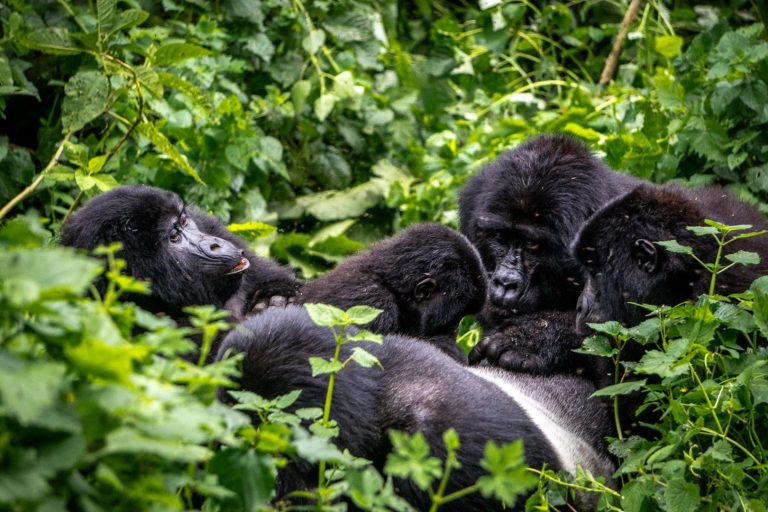
The Kwitonda Gorilla Family is one of the most historically interesting mountain gorilla groups associated with Volcanoes National Park in Rwanda. Unlike many groups whose histories developed entirely within Rwanda, Kwitonda originally formed in the Democratic Republic of Congo before eventually establishing its home range on the Rwandan side of the Virunga Massif.
This cross-border history makes Kwitonda particularly important for understanding mountain gorilla conservation. The gorillas of the Virunga landscape live within an ecosystem shared by Rwanda, Uganda and the Democratic Republic of Congo, and they do not recognize international borders in the way people do.
Introduction
According to the International Gorilla Conservation Programme, the Kwitonda group originated in Virunga National Park in the Democratic Republic of Congo in 1995 and moved into Rwanda in 2003. Its range later became associated with the area between Mount Sabyinyo and Mount Gahinga in Volcanoes National Park.
History of the Kwitonda Gorilla Family
The group's history begins with the silverback after whom it was named.
Kwitonda is believed to have lived as a solitary male before joining another gorilla group known as Rugabo in the Democratic Republic of Congo. Following the death of Rugabo's dominant silverback, Kwitonda separated with several individuals and established his own family.
The family later crossed into Rwanda, where it became established within Volcanoes National Park. This movement demonstrates the regional character of mountain gorilla conservation.
The same Virunga ecosystem extends across national boundaries, which means conservation efforts in one country can directly influence gorillas living in another. The Kwitonda family eventually became one of the habituated groups associated with Rwanda's gorilla tourism program.
What Does Kwitonda Mean?
"Kwitonda" is commonly interpreted as humble or calm in Kinyarwanda. The name became associated with the original dominant silverback and was retained for the family after his death.
Naming mountain gorillas and gorilla groups helps guides, researchers and visitors identify individuals while also communicating the social history of the population. A family name may remain even after the original leader dies, making it part of the group's long-term identity.
Leadership After Kwitonda
The original silverback Kwitonda died in 2012 from old age. His death created an important leadership transition within the family.
According to IGCP, two subordinate silverbacks, Akarevuro and Kigoma, competed for leadership following Kwitonda's death. Akarevuro eventually emerged as the dominant silverback and gained the acceptance of the group. This illustrates an important feature of gorilla society.
Leadership changes can be periods of uncertainty because adult males must demonstrate their ability to protect and maintain the family. Sometimes leadership is transferred relatively peacefully. In other cases, social tension can result in family splits.
Where Is the Kwitonda Gorilla Family Found?
The family is associated with Volcanoes National Park in northwestern Rwanda. Historically, its home range has included areas between Mount Sabyinyo and Mount Gahinga. These volcanoes form part of the dramatic Virunga landscape.
The terrain consists of bamboo zones, montane vegetation and increasingly steep slopes as elevation rises. Because gorillas move naturally throughout their home ranges, visitors cannot know the precise location of Kwitonda before trekking.
Trackers monitor the family and help determine where tourism groups should begin searching.
Kwitonda Family Size
Gorilla family numbers change continuously. Births increase the family. Adult females can transfer between groups.
Young males may leave. New silverbacks can form separate families. IGCP's published family profile listed Kwitonda at 17 members as of January 31, 2024, although its accompanying composition figures illustrate that counts can change and should never be treated as permanent.
For travelers, the practical lesson is simple: use current park information rather than relying on old blogs that present a fixed number of gorillas.
Family Splits and New Groups
Kwitonda's importance extends beyond the current group. The family has contributed to the creation of newer gorilla groups.
IGCP records show that a silverback named Kigoma later left Kwitonda with other individuals, helping form what became the Kwisanga group. More recently, another departure led to formation of the Urwego group. These events highlight how mountain gorilla society constantly evolves.
A family that appears stable for years may eventually divide as males mature and seek leadership.
What Is a Kwitonda Gorilla Trek Like?
A trek to the Kwitonda Gorilla Family begins with the standard morning procedures at Volcanoes National Park. Visitors stay overnight around Kinigi, Musanze or the surrounding countryside. After an early breakfast, they transfer to park headquarters for registration and briefing.
Park authorities then allocate tourists among the habituated families available that day. Once the group has been assigned, visitors travel by vehicle to the most appropriate trekking start point. From there, the search continues on foot with trained guides and trackers.
How Difficult Is the Trek?
The difficulty cannot be predicted with certainty. If Kwitonda is relatively close to the forest edge, the trek may be moderate. If the group has moved farther into the volcanic slopes, the walk can be longer and more demanding.
Rain creates additional challenges. Trails may become muddy, while dense vegetation can make progress slow. Travelers should therefore prepare for several hours of hiking even if the eventual trek is shorter.
What You May See
When the family is located, visitors may observe several different types of behavior. Adult gorillas frequently spend time feeding. Young gorillas may play, climb and chase one another.
Mothers stay close to infants. Silverbacks can often be seen sitting quietly while monitoring the rest of the family. Occasionally there may be vocalizations, displays or interactions between males.
Every encounter is different because the gorillas are not trained or positioned for tourism. Visitors simply observe whatever is happening naturally at the time.
What to Wear
Wear clothing designed for wet mountain conditions. Recommended items include:
- Waterproof hiking boots - Long trousers - Long-sleeved shirt - Waterproof jacket - Gardening gloves - Gaiters - Warm fleece - Small daypack - Drinking water
Avoid bright, impractical safari clothing that provides little protection against vegetation. Comfort and grip are more important than appearance.
Hire a Porter
Hiring a porter is strongly recommended. The Virunga slopes can be steep and slippery. A porter can carry your bag and provide support on difficult sections.
This is useful even for experienced hikers. Porter employment also allows local communities surrounding Volcanoes National Park to benefit directly from gorilla tourism.
Photography
Kwitonda can provide exceptional photographic opportunities. However, forest conditions require preparation. Light may be low, and gorillas can move rapidly between vegetation.
Use a camera capable of handling higher ISO settings if possible. A medium zoom lens is often practical. Keep equipment protected against rain and humidity. Flash photography should not be used.
Can You Request Kwitonda?
Visitors can communicate preferences, but specific family allocations should not be treated as guaranteed. Daily decisions depend on gorilla location, visitor fitness, conservation considerations and operational conditions.
Even if Kwitonda is unavailable on your trekking day, another habituated family can provide an equally memorable experience.
Best Time to Trek
The Kwitonda family can potentially be visited throughout the year when included in current tourism allocations. Relatively drier months may offer firmer walking conditions. Wet periods can produce deeper mud and more slippery trails.
However, rain is possible throughout the year in Volcanoes National Park. Weather should therefore be treated as variable rather than predictable.
Combining Kwitonda with Other Activities
Travelers staying three nights can add golden monkey trekking. Other options include conservation experiences, cultural activities around Musanze and additional hiking opportunities. A longer Rwanda itinerary can combine Volcanoes National Park with Akagera National Park or Nyungwe National Park.
Uganda is also accessible by road for travelers who want to continue toward Bwindi, Mgahinga, Queen Elizabeth National Park or Kibale National Park.
Conservation Importance of Kwitonda
The Kwitonda Gorilla Family tells a larger conservation story. Its movement from Congo to Rwanda demonstrates why mountain gorilla protection must be approached regionally. Its changes in leadership and later family divisions show how social groups develop naturally over generations.
Long-term monitoring by rangers and conservation organizations allows these changes to be documented rather than lost.
For travelers fortunate enough to be allocated to Kwitonda, the experience is therefore more than a wildlife encounter. It is a chance to observe a living family whose history spans countries, generations and decades of mountain gorilla conservation in the Virunga Massif.