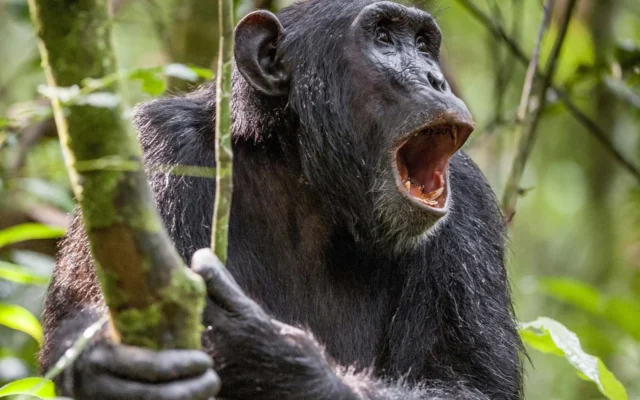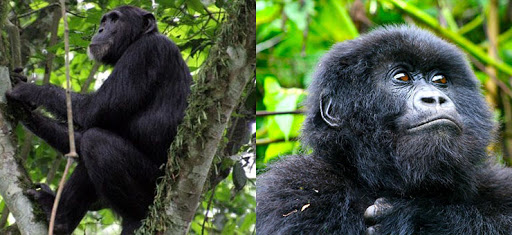
Uganda offers travelers the rare opportunity to see both mountain gorillas and chimpanzees in the wild. Mountain gorillas can be tracked in Bwindi Impenetrable National Park and Mgahinga Gorilla National Park, while Uganda’s most famous chimpanzee trekking destination is Kibale National Park. Both experiences involve entering a rainforest with experienced trackers and searching for one of our closest primate relatives.
Yet the actual encounters feel remarkably different. Gorilla trekking is often quiet, intimate and almost meditative. Chimpanzee trekking can be noisy, fast and unpredictable. So when comparing the gorillas vs chimpanzees experience, which is more exciting? The answer depends entirely on what kind of wildlife experience excites you.
Gorilla Trekking Feels Like an Expedition
A gorilla trek often begins with a strong sense of anticipation. You know the gorillas are somewhere in the forest, but you do not know how long it will take to reach them. The hike can lead through steep slopes, thick vegetation and muddy trails. As trackers begin finding fresh signs, excitement increases. Then someone whispers that the gorillas are close.
Bags may be left with porters. Cameras come out. Voices become quiet. And suddenly, there is a gorilla sitting in the vegetation. The transition from difficult forest trekking to an intimate encounter can be extraordinary.
Chimpanzee Trekking Often Begins With Sound
Chimpanzees can announce themselves before you see them. A distant vocalization echoes through the forest. Another chimp answers. Then several calls erupt from somewhere ahead. The forest suddenly feels alive.
Trackers may change direction and begin moving quickly toward the sound. This creates a different kind of excitement. With gorillas, anticipation often builds through tracking signs. With chimpanzees, sound can become part of the chase.
Gorillas Are Usually Easier to Watch Once Located
Mountain gorillas spend much of their day feeding on vegetation and resting. Once a habituated family is located, visitors may be able to observe several individuals relatively calmly. A silverback may remain seated for long periods. A mother may feed while carrying an infant. Juveniles may wrestle nearby.
The family can move, of course, but gorillas are generally less continuously mobile than chimpanzees. This can make the observation period feel intimate and visually rewarding.
Chimpanzees Can Move Fast
Chimpanzees are highly mobile. A group may feed quietly for several minutes and then suddenly travel through the forest. Visitors may need to follow. Chimpanzees can also climb high into trees, where foliage makes observation and photography more difficult. Then one descends and runs along the forest floor.
Another appears behind you. The experience can change every few minutes. For travelers who enjoy dynamic wildlife behavior, this unpredictability can be thrilling.
Gorilla Encounters Feel Powerful
There is something extraordinary about sitting near a mature silverback. His physical size is immediately impressive. Yet the encounter is often surprisingly peaceful. You may watch him strip leaves from stems, scratch himself, rest or keep an eye on younger gorillas. The contrast between enormous physical power and calm behavior creates much of the emotional impact.
Many travelers describe gorilla trekking as one of the most moving wildlife experiences they have ever had.
Chimpanzees Feel Energetic and Social
Chimpanzee communities operate very differently from typical mountain gorilla families. Individuals may split into smaller parties and later reunite, creating what scientists describe as a fission-fusion social system. This means chimpanzee encounters can involve constantly changing combinations of individuals. Their vocalizations, grooming, displays and social interactions can make the forest feel like a busy primate society.
For behavioral observation, chimpanzees can be fascinating.
Which Trek Is Physically Harder?
Gorilla trekking often has the reputation for being more physically demanding. In Bwindi, gorillas may be located on steep slopes or in thick vegetation. A trek could be relatively short or take several hours. There is no guarantee that your family will be conveniently located near the trailhead. Chimpanzee trekking in Kibale is often less mountainous, although visitors still walk through natural forest and conditions can be muddy or uneven.
However, chimpanzees can require faster movement once located. So the challenges differ. Gorillas may demand endurance. Chimpanzees may demand agility.
Which Is Better for Photography?
For many photographers, gorillas have an advantage. Once a family settles, visitors may have opportunities to compose portraits and observe individuals at relatively predictable positions. The forest is still dark, and vegetation can obstruct views, but gorillas’ slower movement can help. Chimpanzee photography can be more challenging. Animals may move quickly or remain high in the canopy.
Lighting conditions inside the forest can be difficult. But when everything comes together, chimpanzee photographs can be incredibly dynamic.
Gorilla Photography Rewards Patience
A resting silverback can give you time to think about composition. You can wait for him to raise his head. A mother may reposition an infant. A juvenile might climb into a better opening. The encounter often allows photographers to slow down. That does not guarantee easy photographs. Rainforest light can still be challenging. But the pace can be more forgiving.
Chimpanzee Photography Rewards Speed
Chimpanzees may give you only seconds. A chimp descends a tree. Another crosses the trail. A male begins displaying. Two individuals start grooming. The photographer must react quickly. This makes chimpanzee photography exciting for people who enjoy action and behavioral images.
Which Feels More “Wild”?
Both experiences are genuinely wild. Habituated gorillas and chimpanzees are accustomed to controlled human presence but remain free-ranging animals. However, the experiences can feel wild in different ways. Gorilla trekking feels like penetrating deep into a mountain forest to find a hidden family. Chimpanzee trekking can feel like trying to keep up with an intelligent, noisy community moving through its territory.
Neither is more authentic. They simply reveal different primate worlds.
Which Animal Feels More Human?
This is subjective. Gorillas often create emotional recognition through body language. The way a mother holds an infant or an adult sits quietly can seem remarkably familiar. Chimpanzees may appear human in a different way. Their complex social interactions, facial expressions, grooming, alliances and energetic communication can feel strikingly recognizable.
Seeing both species makes their differences—and our similarities—even more fascinating.
The Soundscape Is Completely Different
Gorilla encounters can be remarkably quiet. You may hear leaves tearing, branches moving, low vocalizations and the sounds of the forest. Chimpanzees can transform the atmosphere. Their calls travel considerable distances. A sudden eruption of vocalization can make the entire forest seem to respond.
For some travelers, hearing wild chimpanzees before seeing them becomes one of the highlights of the trek.
Which Has the Bigger “Wow” Moment?
For many first-time visitors, gorillas probably win the initial visual impact. Seeing a huge silverback only meters away is difficult to compare with anything else. Mountain gorillas also live naturally in a very limited geographical range, adding to the sense of rarity. Chimpanzees, however, can deliver repeated bursts of excitement.
The “wow” may come from following a display, hearing an explosive chorus of calls or suddenly finding yourself surrounded by moving chimpanzees.
Which Is Better for Families?
Age regulations apply to primate trekking and should always be checked before booking. For eligible family travelers, the choice also depends on physical ability and interest. Gorilla trekking may involve longer and steeper hiking. Chimpanzee trekking can require quick movement through forest. Neither should be treated like a zoo visit.
Children and teenagers participating must be capable of following ranger instructions and behaving appropriately around wildlife.
Which Is Better for Older Travelers?
Physical fitness matters more than age alone. For gorilla trekking, travelers can discuss their mobility with their safari operator and park guides. Where possible, trekking allocations may take physical considerations into account, although gorilla location can never be guaranteed. Hiring a porter is strongly recommended. Chimpanzee trekking can also involve uneven terrain and rapid repositioning.
Anyone with mobility concerns should discuss both activities before booking.
Why You Should Do Both
The most satisfying answer to gorillas versus chimpanzees is often: do not choose. Uganda makes combining both experiences relatively straightforward. A classic primate safari can include chimpanzee trekking in Kibale followed by wildlife viewing in Queen Elizabeth National Park and gorilla trekking in Bwindi. This creates a remarkable progression. You experience chimpanzee society.
You enjoy savannah wildlife. Then you enter the mountains for gorillas.
A Classic Uganda Primate Route
A typical itinerary might begin from Entebbe or Kampala and travel west toward Kibale. After chimpanzee trekking, continue to Queen Elizabeth National Park for game drives and a Kazinga Channel boat cruise. From there, drive south through the Ishasha area toward Bwindi. Finish with mountain gorilla trekking before returning toward Entebbe or continuing to Kigali, depending on the itinerary.
This route combines several of Uganda’s strongest wildlife experiences.
Which Is More Expensive?
Gorilla trekking generally represents the larger permit investment. Chimpanzee trekking can therefore be easier to add to a broader safari budget. Travelers should check current official permit rates when planning because prices and regulations can change. Cost, however, should not be the only factor. The experiences are different enough that one does not substitute perfectly for the other.
Which Is More Emotional?
Gorillas often produce the stronger emotional reaction. Their size, calmness and family relationships create a powerful atmosphere. Sitting quietly near them can feel almost unreal. Chimpanzees may appeal more strongly to travelers fascinated by animal intelligence, communication and social behavior. One experience can leave you silent.
The other can leave you exhilarated.
Which Is More Exciting?
If excitement means dramatic hiking followed by a close, powerful wildlife encounter, choose gorillas. If excitement means movement, noise, unpredictable behavior and trying to keep pace with animals through the forest, chimpanzees may win. If you love wildlife deeply, the comparison becomes almost impossible.
Gorillas vs Chimpanzees: The Final Verdict
The gorillas vs chimpanzees experience is not really a competition. Mountain gorillas offer intimacy. Chimpanzees offer energy. Gorillas often allow you to slow down and study a family. Chimpanzees can force you to react quickly as their social world unfolds around you.
Gorillas impress through physical presence. Chimpanzees fascinate through movement, sound and complex behavior. The best Uganda primate safari includes both. See the chimpanzees first and feel the forest erupt with calls. Then travel south to Bwindi and sit quietly near a silverback.
By the end, you may discover that asking which is better misses the most interesting point. Uganda allows you to experience two completely different expressions of great ape life in the wild—and understanding one makes watching the other even more extraordinary.

 Read