You hear them before you see them. Somewhere inside the forest comes a distant call. Your ranger stops. Everyone becomes quiet. Another chimpanzee answers from a different direction.
Then the forest erupts. Several voices echo through the trees and your guide immediately begins moving toward the sound. This is one of the defining differences between chimpanzee trekking and many other wildlife experiences. It can feel less like walking toward an animal and more like being pulled into the middle of an active primate society.
Introduction
For travelers wondering what is chimpanzee trekking like, Uganda’s Kibale National Park provides one of the best places to find out.
The Experience Begins Quietly
A chimpanzee trek normally begins at a designated briefing point. Visitors meet ranger guides and receive instructions about the forest, trekking procedures and appropriate behavior around chimpanzees. At this stage, everything can feel calm. You adjust your backpack. Check your camera.
Make sure you have drinking water. Then your group enters the forest. For the first few minutes, you may see no sign of chimpanzees at all.
Kibale Feels Like a Living Forest
Kibale is not simply a backdrop for chimpanzees. The forest itself is part of the experience. Tall trees rise overhead. Vines cross the understory. Bird calls come from the canopy.
Monkeys may move through branches above you. Your guide might stop to point out plants, animal tracks or other primates. Even before chimpanzees appear, the walk introduces you to an extraordinarily diverse tropical forest.
Trackers Are Looking for Clues
Chimpanzees do not wait beside the trail. Guides and trackers use several clues to locate them. Fresh feeding remains can show where chimpanzees have been active. Dung can indicate recent presence. Nests provide evidence of where chimpanzees slept.
But sound is often particularly valuable. Chimpanzees communicate loudly. Experienced guides listen constantly.
Then You Hear the First Call
For many visitors, this is when the trek changes. A chimpanzee vocalization can travel through the forest from far away. Your guide may immediately recognize the direction. The group begins moving. Sometimes the calls stop.
Everyone listens again. Then another vocalization provides a new clue. The search becomes interactive. You are not simply walking along a predetermined trail. You are responding to animals moving somewhere inside a three-dimensional forest.
Chimpanzees Can Be High in the Trees
Your first sighting may not be the perfect eye-level encounter you imagined. A guide points upward. You stare into the canopy. At first you see only leaves. Then a branch moves.
A dark shape becomes visible. Suddenly you realize a chimpanzee is sitting high above you, feeding on fruit. Another appears nearby. Watching chimpanzees in the canopy can be fascinating, but it can also test your neck muscles and photography skills.
Then Everything Can Change
A chimpanzee climbs down. The guide tells everyone to move. Another chimp begins traveling through the forest. Within moments, the quiet observation becomes an energetic pursuit. You walk quickly along a trail. Turn into the vegetation. Stop. Move again. This unpredictability is a major part of chimpanzee trekking. The animals decide the pace.
Chimps Are Not Gorillas
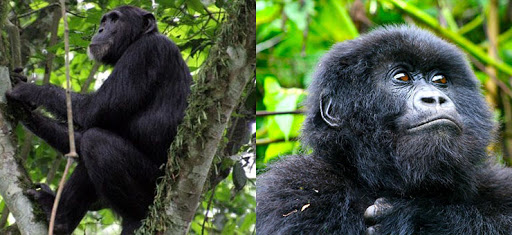
Travelers who have already experienced gorilla trekking sometimes expect something similar. Chimpanzees quickly destroy that expectation. Mountain gorillas often spend long periods feeding or resting relatively close together. Chimpanzees can be much more dispersed and mobile. Individuals may be on the ground while others remain high in trees.
Small parties can separate and reunite. One moment you are watching three chimpanzees. A few minutes later there may be many more. The encounter feels fluid.
The Forest Can Suddenly Become Loud
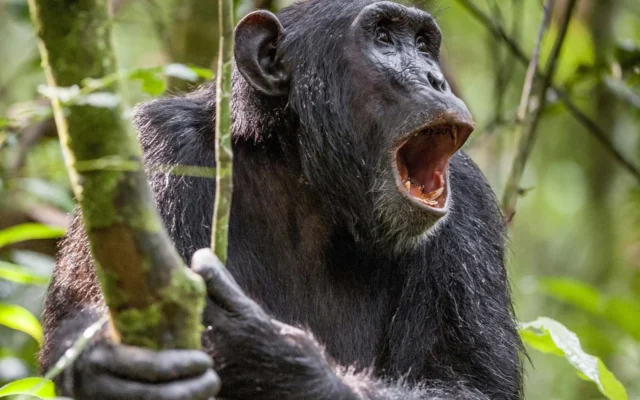
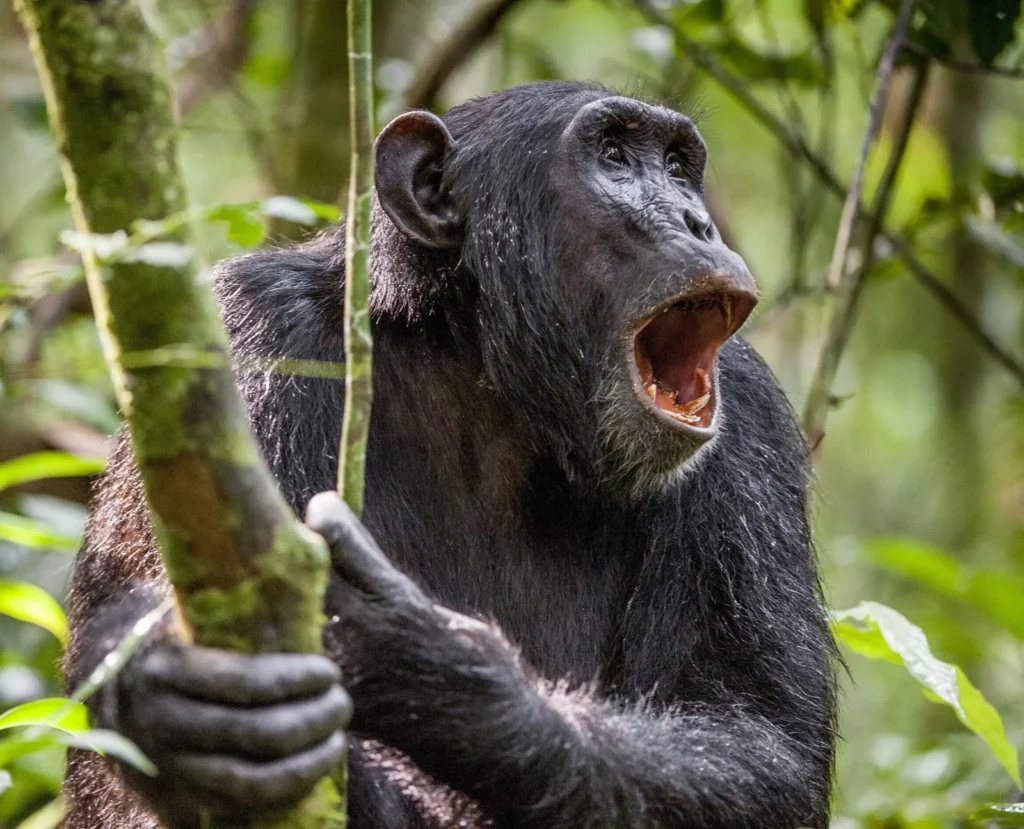
Chimpanzee vocalizations are one of the most memorable parts of the experience. Calls may begin with one individual and spread through the community. The sound can be surprisingly powerful. When several chimpanzees vocalize nearby, the forest atmosphere changes instantly. Visitors often stop talking altogether. Hearing chimpanzees in a documentary is one thing. Standing inside a Ugandan rainforest while wild chimpanzees call around you is completely different. You feel the sound physically as well as hear it.
Chimpanzees Have Individual Personalities
As observation continues, the animals stop looking like anonymous dark shapes. You begin noticing differences. One male may sit confidently in an open area. Another remains at the edge of the group. A youngster plays.
Two adults groom. A mother moves with an infant. Experienced guides may recognize individuals and explain their relationships or position within the community. This transforms the encounter. You are no longer watching “chimpanzees.” You are watching individual animals participating in a complex society.
Grooming Can Be Fascinating
Grooming is much more than hygiene. It plays an important role in chimpanzee social relationships. Watching two chimpanzees carefully groom one another can appear peaceful, but the behavior exists within a complex network of alliances and relationships. Who spends time with whom can matter. Guides can help interpret what you are seeing and explain the community’s social structure. This makes chimpanzee trekking particularly rewarding for travelers interested in animal behavior.
Displays Can Be Dramatic
Adult males may display. A chimpanzee can suddenly move with extraordinary energy, charge through vegetation, shake branches or create noise. To an inexperienced visitor, this may appear aggressive. Your ranger understands the context and tells the group how to respond. The safest approach is always to remain calm and follow instructions. Displays are one of the moments when you are reminded that these are powerful wild animals.
They Can Seem Uncomfortably Human
Chimpanzees fascinate us partly because aspects of their behavior seem familiar. Hands manipulate objects. Faces communicate emotion. Youngsters play. Adults form relationships. Individuals become excited, irritated or relaxed. But visitors should avoid projecting human explanations onto every action. Chimpanzees have their own evolutionary history and social world. The similarities are fascinating precisely because the differences remain substantial.
What Does the Forest Smell Like?
Chimpanzee trekking is a sensory experience. You notice damp soil. Decaying leaves. Fresh vegetation. The smell after rain.
Occasionally, when chimpanzees have recently occupied an area, guides may identify signs that experienced trackers detect long before visitors do. This sensory dimension is difficult to communicate through photographs. It is one reason being physically present in the forest feels so different from watching wildlife on television.
Is Chimpanzee Trekking Difficult?
The physical difficulty varies. Some groups may be located relatively quickly. Other searches require longer walking. Kibale’s terrain is generally different from the steep mountain slopes associated with many Bwindi gorilla treks, but conditions can still be muddy and uneven. The bigger challenge can sometimes be pace.
When chimpanzees move, visitors may need to reposition quickly. Comfortable walking shoes and reasonable fitness are helpful.
What Happens When It Rains?
Kibale is a rainforest. Rain is part of the ecosystem. A clear morning can become wet surprisingly quickly. Trails may become slippery. Vegetation drips.
Camera equipment needs protection. But rain does not necessarily ruin the experience. The forest after rainfall can be beautiful, and wildlife activity continues. Pack a lightweight waterproof layer and protect electronics appropriately.
Photography Can Be Challenging
Chimpanzee trekking is not a controlled photoshoot. Light inside the forest can be limited. Chimpanzees may sit beneath dark vegetation or high in the canopy against a bright sky. They also move quickly. Photographers often need to react rather than carefully stage compositions.
A camera capable of handling higher ISO settings can be useful. But do not spend the entire encounter staring through a viewfinder. Some of the best moments happen too quickly to photograph perfectly.
Sometimes the Best Choice Is to Put the Camera Down
A chimpanzee sits only a short distance away. Another begins grooming it. A youngster appears. You raise your camera and start adjusting settings. By the time everything is correct, the moment has changed. Chimpanzee trekking teaches photographers an important lesson. Not every memory needs to become a photograph. Occasionally, put the camera down. Watch. Listen. Let the experience happen.
How Close Do You Get?
Distance depends on the situation and current park regulations. Visitors should follow ranger instructions rather than attempting to determine their own viewing distance. Chimpanzees themselves may move unpredictably. An individual can cross a trail or pass through an area where visitors are standing. Do not chase or touch it.
Allow the animal to choose its route.
Health Rules Matter
Chimpanzees are biologically similar enough to humans that disease transmission is an important conservation concern. Visitors should not participate when seriously ill and should follow current health requirements. Do not feed chimpanzees. Do not touch them. Follow instructions about coughing, sneezing, waste and appropriate distance.
Responsible tourism helps protect the community you have traveled to see.
How Long Are You With the Chimpanzees?
The exact structure of the experience depends on the permit and current regulations. Standard chimpanzee tracking typically provides a controlled observation period once the chimpanzees are located. Uganda has also offered longer habituation-oriented chimpanzee experiences for travelers interested in spending additional time following research and monitoring activities. Always confirm current options when booking.
The Habituation Experience Feels Different
A chimpanzee habituation experience can involve spending much more time following the community’s daily activity. For serious primate enthusiasts, photographers and travelers interested in behavior, this can provide deeper insight. You may observe changes in feeding, movement and social interactions across a longer period. It can also be physically more demanding.
Other Primates Add to the Experience
Kibale is famous for its primate diversity. While searching for chimpanzees, visitors may encounter other monkeys depending on location and luck. This makes the forest walk rewarding even before the main encounter. Birders also have plenty to listen and look for. The chimpanzees may be the headline attraction, but Kibale is a complete forest ecosystem.
Is a Sighting Guaranteed?
Wildlife should never be described with absolute guarantees. Chimpanzees are free-ranging animals. Habituated communities are monitored and experienced trackers have excellent knowledge of their movements, giving visitors strong chances of finding them. But nature remains nature. This uncertainty is part of what separates trekking from visiting captive animals.
You are searching for wildlife on its terms.
The Moment It Becomes Real
Before the trek, chimpanzees may exist in your mind as documentary animals. You know they are intelligent. You have seen photographs. You understand that they are closely related to humans. Then one walks past you.
Suddenly all that information becomes physical. You notice the size of its hands. The texture of its hair. The way its eyes scan the forest. The intelligence seems less abstract. That is often the moment chimpanzee trekking becomes unforgettable.
How Does It Compare With a Game Drive?
A game drive allows you to cover large distances comfortably from a vehicle. Chimpanzee trekking is much more immersive. You are inside the habitat. There is no vehicle separating you from the forest. You hear every branch break.
You feel the humidity. You respond to the animals’ movements. This creates a sense of participation that conventional wildlife viewing rarely provides.
Combine Chimpanzees With Gorillas
One of Uganda’s greatest advantages is the ability to combine chimpanzee trekking with mountain gorilla trekking. A safari can travel from Kibale to Queen Elizabeth National Park and then continue south toward Bwindi. The experiences complement each other beautifully. Chimpanzees provide speed, noise and complex social activity. Gorillas provide physical presence, family intimacy and a slower observation style.
Together, they form one of Africa’s finest primate safari combinations.
So, What Is Chimpanzee Trekking Really Like?
It is unpredictable. You may walk quietly for an hour and then suddenly find yourself moving quickly toward a chorus of calls. You may spend several minutes staring high into a tree before a chimpanzee unexpectedly descends. You may watch peaceful grooming followed moments later by an explosive display. It can be frustrating for photographers, fascinating for behavioral observers and thrilling for almost anyone interested in primates.
Most importantly, it feels alive. The forest is not a stage and the chimpanzees are not performers. You enter their habitat for a short period and attempt to keep up with whatever they decide to do. That is what chimpanzee trekking is like. You listen.
You search. You follow. And then, somewhere beneath the canopy of Kibale National Park, a wild chimpanzee looks in your direction and reminds you that some of the world’s greatest wildlife encounters happen not from the seat of a safari vehicle, but on foot inside a forest.

 Read