
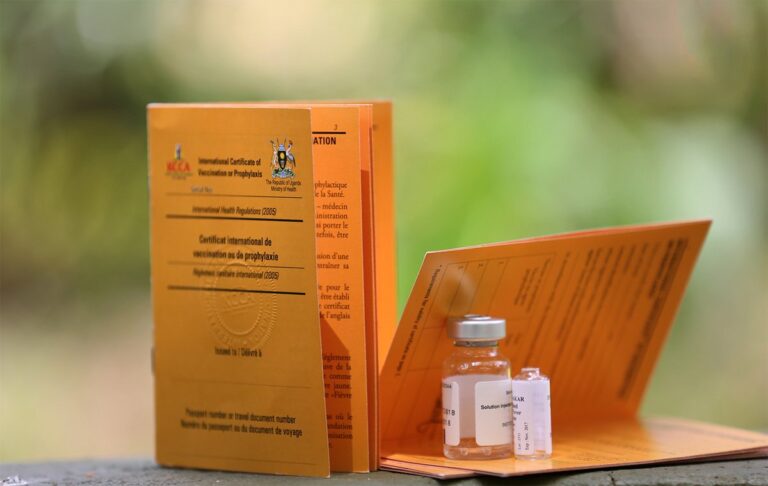
Understanding the Uganda yellow fever requirements is essential when preparing for a gorilla trekking or wildlife safari. Uganda lies within a region where yellow fever transmission can occur, and vaccination serves both as an important health protection measure and as an international travel requirement.
As of August 2026, current CDC guidance states that yellow fever vaccination is required for travelers arriving in Uganda who are one year of age or older. The CDC also recommends yellow fever vaccination for travelers to Uganda from the age of nine months.
Introduction
Uganda’s Ministry of Health also identifies yellow fever vaccination documentation as a requirement connected with international travel. Travel-health rules can change, so travelers should verify official information and speak with a qualified medical professional before departure.
What Is Yellow Fever?
Yellow fever is a viral disease transmitted through the bites of infected mosquitoes. It occurs in parts of tropical Africa and South America. Illness can range from mild symptoms to severe disease. Symptoms can include:
– Fever – Headache – Muscle pain – Nausea – Vomiting – Weakness
A smaller percentage of infected people develop severe disease that can involve jaundice, bleeding and organ failure. Because there is no specific antiviral cure for yellow fever, prevention is extremely important.
Is Yellow Fever Vaccination Required for Uganda?
Yes, current travel-health guidance identifies Uganda as a country requiring proof of yellow fever vaccination for arriving travelers aged one year and older. Travelers should therefore regard vaccination and the corresponding certificate as an important part of safari preparation rather than an optional detail.
Always carry the original recognized vaccination certificate with your travel documents.
Is Yellow Fever Vaccination Recommended as Well as Required?
The requirement concerns entry documentation, but there is also an actual risk of yellow fever transmission. Current CDC guidance recommends the vaccine for travelers aged nine months and older visiting Uganda. This distinction matters.
The vaccination is not simply bureaucratic paperwork; it is intended to protect travelers and populations from a serious mosquito-borne disease.
The International Yellow Fever Certificate
After receiving a qualifying yellow fever vaccination at an authorized center, travelers should receive an International Certificate of Vaccination or Prophylaxis, commonly called the yellow fever card or certificate. The certificate should be completed correctly and validated by the authorized vaccination center.
It is an important travel document. Keep it with your passport. Do not pack it in checked luggage where it may be inaccessible during entry formalities.
When Does a Yellow Fever Certificate Become Valid?
For a first yellow fever vaccination, the international certificate generally becomes valid 10 days after vaccination. CDC guidance explains that a properly completed certificate becomes valid beginning 10 days after the primary vaccination. This means first-time travelers should obtain the vaccine well before their departure date. Do not schedule the vaccination the day before flying and assume the certificate will automatically satisfy international requirements.
How Long Is the Yellow Fever Certificate Valid?
Under international health regulations, a valid qualifying yellow fever vaccination certificate is recognized for the lifetime of the vaccinated person. The change establishing lifetime certificate validity came into effect internationally in July 2016. Travelers with an old valid certificate should therefore not automatically assume they require a booster purely because ten years have passed. However, individual medical circumstances should be discussed with a health professional.
Do You Need a Yellow Fever Booster?
Routine booster vaccination solely for certificate validity is generally no longer required under the lifetime-validity rule. Nevertheless, a healthcare professional may recommend additional vaccination in particular medical or exposure circumstances. The decision should be based on medical guidance rather than simply obtaining repeated doses for paperwork. Bring your existing certificate to the travel clinic so the clinician can review it.
Where Should You Get the Yellow Fever Vaccine?
Yellow fever vaccination should be obtained from an authorized vaccination center capable of issuing a recognized international certificate. Depending on your country, these may include:
– Travel clinics – Public-health centers – Selected hospitals – Authorized vaccination clinics
Availability can vary, and some travelers require medical assessment before vaccination. Do not obtain an unofficial certificate. A forged or invalid vaccination document can create serious immigration problems and does nothing to protect your health.
Yellow Fever for Children Traveling to Uganda
The age thresholds are important. Current CDC information states that Uganda’s country entry requirement applies to arriving travelers aged one year and older, while vaccination is generally recommended for travelers aged nine months and above.
Parents should consult a pediatric or travel-health specialist before departure. Vaccination decisions for infants require particular medical consideration. Never assume adult advice can simply be applied to a young child.
Travelers Who Cannot Receive the Vaccine
Some travelers may be unable to receive yellow fever vaccination because of a medical contraindication. Examples can involve certain immune conditions, serious vaccine allergies or other health circumstances. Anyone concerned about vaccine safety should speak with an experienced travel-medicine professional.
Do not simply decide to travel without the vaccine certificate. A medical practitioner may provide appropriate documentation when vaccination is medically contraindicated, but acceptance of waivers is ultimately subject to destination-country rules. Verify arrangements in advance.
Yellow Fever and Pregnancy
Pregnant travelers require individualized medical advice. The risks of vaccination must be considered alongside the risk of yellow fever exposure and the destination’s entry requirements. Anyone pregnant or planning pregnancy should discuss the complete Uganda itinerary with a travel-health specialist. The answer may depend on the areas being visited, timing and individual medical circumstances.
Yellow Fever and Older Travelers
Age alone does not automatically determine whether someone should or should not receive the vaccine. However, older travelers may require a more detailed assessment of vaccine risks and benefits. Tell the clinician about: – Age – Existing medical conditions – Current medication – Previous vaccinations – Previous yellow fever vaccine reactions – Planned itinerary Personalized medical advice is essential.
Yellow Fever at Entebbe International Airport
Most international visitors enter through Entebbe International Airport. Keep your vaccination certificate accessible with your passport and visa documentation. Entry procedures can include review of health-related documentation.
Do not leave the yellow fever card buried inside checked luggage. A practical travel wallet containing all major entry documents can simplify arrival.
Yellow Fever Requirements at Uganda Land Borders
The same need to prepare health documentation applies when entering Uganda by road. This is particularly relevant for travelers arriving from Rwanda or Kenya. A common itinerary begins at Kigali International Airport before driving into Uganda for gorilla trekking in Bwindi. Carry your original yellow fever certificate during the border crossing. Do not assume road entry is less formal than airport entry.
Yellow Fever and the Uganda Visa
Yellow fever documentation can also be relevant during Uganda immigration procedures. Uganda Immigration lists a yellow fever vaccination certificate among supporting documents for several immigration categories, including the East Africa Tourist Visa and multiple-entry visa.
Travelers should follow the exact upload requirements shown when completing their particular online application.
Yellow Fever and the East Africa Tourist Visa
Travelers applying through Uganda for the East Africa Tourist Visa are currently required to provide a vaccination certificate for yellow fever as part of the supporting documentation. The regional visa can cover Uganda, Rwanda and Kenya for qualifying tourism travel. Health rules, however, should still be checked separately because visa validity does not automatically eliminate public-health entry requirements.
Is Yellow Fever Present in Uganda?
Uganda lies within the African yellow fever risk zone. The CDC identifies Uganda among African countries with a risk of yellow fever transmission. Mosquito control and vaccination therefore remain important public-health measures.
Travelers should not think of vaccination only as a border requirement.
Mosquito-Bite Prevention Still Matters
Yellow fever vaccination does not protect against every mosquito-borne disease. Uganda also has malaria risk, and CDC guidance currently recommends malaria preventive medication for travelers visiting the country. Travelers should reduce mosquito bites by using:
– Effective insect repellent – Long-sleeved clothing where practical – Long trousers in evenings – Mosquito nets where provided – Screened rooms – Appropriate malaria prophylaxis as medically advised
Preventive measures remain valuable even after yellow fever vaccination.
Yellow Fever and Gorilla Trekking
A yellow fever certificate is unrelated to the gorilla trekking permit itself. Travelers sometimes confuse health, immigration and park documents. For a Uganda gorilla safari, you may need several separate items:
1. Passport 2. Uganda visa or visa exemption 3. Yellow fever documentation 4. Gorilla trekking permit 5. Travel insurance 6. Safari booking confirmation
Each serves a different purpose. Your tour operator normally arranges the gorilla permit, while vaccination remains the traveler’s medical responsibility.
Gorilla Health Protection
Mountain gorillas are highly vulnerable to human respiratory illnesses. Yellow fever vaccination is primarily about protecting the traveler and satisfying health-entry requirements; it is not the primary mechanism protecting gorillas. Gorilla conservation protocols can include rules concerning illness, distance and visitor behavior. If you are sick near your trekking date, notify your operator or ranger team. Never hide symptoms simply to avoid missing a trek.
Other Vaccinations for Uganda
Yellow fever may be the most visible travel requirement, but it should form part of a broader health consultation. Depending on the traveler, recommendations may include attention to:
– Routine vaccinations – Hepatitis A – Hepatitis B – Typhoid – Rabies – Measles – Tetanus – Polio – Malaria prevention
Current CDC guidance recommends hepatitis A vaccination for unvaccinated travelers to Uganda and malaria preventive medication for travelers visiting the country. Your doctor should make recommendations based on your personal history and itinerary.
When Should You Visit a Travel Clinic?
Ideally, arrange your travel-health appointment well before departure. CDC advises travelers to see a doctor at least about a month before travel where possible so that necessary vaccinations and medications can be organized.
Early planning is particularly important when yellow fever vaccination is required because the primary certificate needs time to become valid.
Protect Your Yellow Fever Certificate
Treat the certificate almost like a passport. Before traveling:
– Check that your name is correct – Confirm vaccination date – Check clinic validation – Make sure the certificate is legible – Photograph or scan it as backup – Keep the original in hand luggage
A digital photograph is useful as a backup but should not automatically be assumed to replace the original international certificate.
What If You Lose Your Yellow Fever Card?
If the certificate is lost before travel, contact the clinic where you received the vaccine. If the vaccination record can be verified, an authorized center may be able to advise on replacement documentation. Do not leave this until arrival at the airport. If the card is lost during your safari, inform your tour operator and retain any digital evidence while seeking professional guidance.
Common Yellow Fever Mistakes
– Waiting until the final days before travel for first vaccination – Leaving the certificate at home – Packing it in checked baggage – Assuming vaccination is required only when arriving from another African country – Buying an unofficial certificate – Believing a gorilla permit replaces health documentation – Assuming an old certificate has automatically expired – Ignoring medical advice when contraindications apply
Uganda Yellow Fever Checklist
Before departure, confirm:
– You have received qualified medical advice – Your vaccination status is appropriate – Your primary vaccination was given early enough – Your certificate is correctly completed – You have the original certificate – Your passport details are correct – You understand malaria prevention – You have travel insurance – Your Uganda visa and gorilla permit are separately arranged
Yellow Fever Preparation for a Uganda Safari
The Uganda yellow fever requirements are straightforward when addressed early. For most safari travelers aged one year and older, carrying valid vaccination documentation should be treated as part of the essential travel paperwork.
Arrange the travel-health consultation early, keep your certificate secure and verify requirements again before departure.
Once these preparations are complete, your attention can shift to the reason for traveling: trekking mountain gorillas in Bwindi or Mgahinga, tracking chimpanzees in Kibale, watching wildlife in Queen Elizabeth or Murchison Falls and exploring one of Africa’s most biologically diverse safari destinations.
Proper health preparation is not merely an administrative step—it is part of traveling responsibly and arriving ready to enjoy Uganda safely.