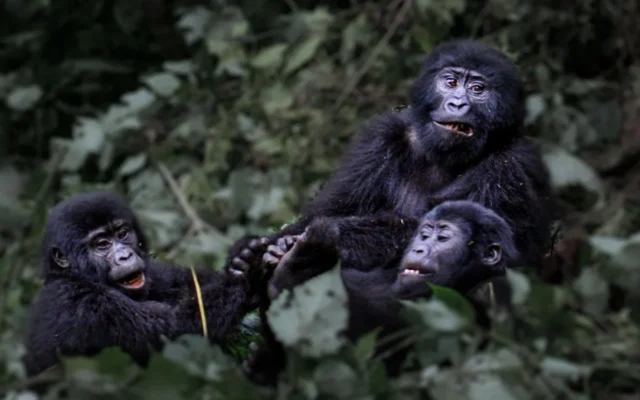
To a first-time visitor, Bwindi Impenetrable Forest can seem almost impossible to navigate. Trees overlap above you. Ferns crowd the forest floor. Vines twist around trunks. Valleys disappear below steep slopes. Trails branch into vegetation, and after only a few minutes of walking, many visitors would struggle to determine which direction they came from.
Yet every morning, experienced trackers enter this enormous forest and begin searching for specific mountain gorilla families. Hours later, tourists frequently find themselves standing only meters from those gorillas. So how do trackers find mountain gorillas in a rainforest that appears almost impenetrable? There is no GPS collar directing them toward a flashing dot on a screen.
Introduction
Instead, gorilla tracking depends on detailed knowledge of individual families, their previous locations, forest ecology and subtle physical evidence left behind as gorillas travel and feed. It is one of the least visible but most fascinating parts of the gorilla trekking experience.
The Search Does Not Start Randomly
The first thing to understand is that trackers do not walk into Bwindi each morning and simply begin searching thousands of hectares of forest at random. Habituated mountain gorilla families are regularly monitored. Teams know where a group was previously observed and often where it settled toward the end of the day. This creates a logical starting point for the next morning’s tracking.
The trackers return toward the last known location and begin examining what happened after the previous observation ended. From there, the forest becomes a trail of evidence.
Gorilla Nests Provide an Important Starting Point
Mountain gorillas construct nests when resting, particularly for the night. These nests are made using vegetation that gorillas bend and arrange into sleeping platforms. A fresh nesting site can reveal several things. It confirms that gorillas recently occupied the area. The number and distribution of nests can provide information about the group.
Trackers can then inspect the surrounding vegetation to determine which direction the gorillas traveled after leaving. For a visitor, the nests may initially look like flattened vegetation. For an experienced tracker, they are part of a much larger story.
Freshness Matters
Tracking is not simply about finding a broken branch. Bwindi is full of broken vegetation. Trees fall. Animals move. Wind damages plants. People may have used a trail previously. The real skill is determining whether a sign was created by gorillas and how recently it appeared. Fresh plant material looks different from vegetation damaged days earlier. Moisture levels change. Leaves wilt. Broken stems discolor. Dung changes over time. Footprints soften with rain and traffic. Trackers learn to evaluate these details quickly.
Feeding Signs Are Everywhere—If You Know How to Read Them
Mountain gorillas spend a large portion of their day feeding. As they move, they pull leaves from plants, break stems, strip vegetation and leave discarded plant material behind. This creates feeding trails. Imagine walking through thick vegetation and noticing a group of plants that have recently been bent in the same direction. Certain stems are freshly snapped.
Leaves have been removed. Pieces lie on the forest floor. To most trekkers, it simply looks messy. To a tracker, it may indicate exactly where gorillas passed and what they were eating.
Different Foods Create Different Clues
Gorillas consume a variety of plant materials depending on availability and location. That means feeding signs are not identical everywhere. Trackers need detailed botanical knowledge. They recognize plant species used by gorillas and understand how gorillas typically handle them. This allows them to distinguish gorilla feeding from damage caused by other animals. It also helps trackers anticipate where a family might move next. If a particular feeding area is productive, gorillas may remain nearby. If food becomes less attractive, they may continue traveling.
Footprints Can Help
Gorilla footprints may occasionally be visible where ground conditions allow. Soft soil, mud and damp stream margins can preserve impressions. A large silverback can leave substantial signs. Smaller gorillas produce correspondingly smaller tracks. However, footprints are not available everywhere.
The forest floor may be covered in leaves, roots or dense vegetation. Rain can erase evidence. Other animals and people may disturb the ground. Trackers therefore combine footprints with other clues rather than relying on them alone.
Gorilla Dung Is Valuable Evidence
Dung is another important sign. Its presence confirms that gorillas occupied a location. Freshness provides information about timing. Combined with feeding evidence and travel direction, dung can help trackers estimate whether they are hours behind the family or beginning to close the distance.
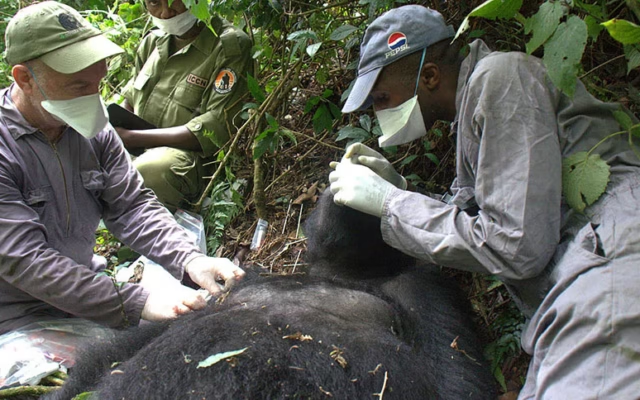
Researchers can also obtain scientific information from gorilla fecal material, although tourist tracking and formal scientific sampling are separate processes. For everyday tracking, its value is primarily one piece within a chain of evidence.
Broken Vegetation Can Reveal Direction
Imagine a gorilla pushing through a patch of dense plants. Its body weight bends vegetation. Hands pull stems. Branches snap. Leaves are displaced.
When multiple gorillas travel through the same area, they can create a subtle corridor through the vegetation. Trackers examine the orientation of broken plants and disturbed ground to determine direction. Then they follow. The challenge is that gorillas do not always move in a straight line.
Gorillas Can Change Direction
A family may travel downhill, stop to feed and then move sideways across a slope. It may circle around productive vegetation. Individuals can spread out while feeding before regrouping. Terrain can influence movement. This means tracking requires constant interpretation.
A sign pointing west does not mean the gorillas continued west for the next two kilometers. Trackers repeatedly reassess the evidence. The fresher the signs become, the closer they may be getting.
Sounds Become Important at Close Range
Mountain gorillas are not silent. They communicate using a range of vocalizations and physical displays. When trackers get close enough, sounds can help reveal the family’s position. Vegetation may move. Branches may break.
A gorilla may vocalize. A silverback's chest beat can travel through the forest. At this stage, trackers often slow down and listen carefully. Visitors may notice the atmosphere suddenly becoming quieter. Conversations stop.
Everyone pays attention. The gorillas may be nearby.
Smell Can Sometimes Provide Another Clue
Large primates living together in dense vegetation can produce noticeable scents. Experienced trackers may sometimes use smell as another indication that gorillas are close. It is not a magical tracking technique or something used in isolation. Rather, it becomes another piece of environmental information combined with sounds, fresh vegetation and other signs. When multiple clues become increasingly recent, trackers know they are closing the gap.
Trackers Know Individual Gorilla Families
The work goes beyond identifying “some gorillas.” Habituated groups are individually known and monitored. Trackers and researchers can recognize individual gorillas based on physical features and other identifying characteristics. They understand group composition. They know the dominant silverback.
They may know mothers, juveniles and infants. They are also familiar with the family's normal ranging behavior. This knowledge matters. If a particular family frequently uses certain parts of its range at a particular time, that experience helps inform the search. However, trackers still rely on actual evidence rather than simply assuming where gorillas should be.
What Does “Habituated” Mean?
Habituation is the gradual process through which a wild gorilla family becomes accustomed to the controlled presence of trained humans. It does not mean the gorillas are domesticated. They remain wild. The process involves researchers and habituation teams spending carefully managed time around a group over an extended period. Eventually, when authorities determine that the family is sufficiently accustomed to human observers, it may become available for regulated tourism. Habituation is one reason trackers can monitor particular families consistently.
Why Don't Gorillas Just Run Away From Trackers?
Habituated gorillas have learned that the controlled presence of rangers, researchers and properly managed tourist groups does not normally represent a threat. That does not mean visitors can behave however they want. Strict rules remain essential. Noise should be controlled. Visitors follow ranger instructions.
Appropriate distance is maintained whenever possible. Flash photography is prohibited. Ill visitors should not participate because human diseases can pose serious risks to gorillas. Habituation works because human encounters remain predictable and carefully controlled.
Trackers Enter the Forest Before Many Visitors
One of the remarkable things about a gorilla trekking morning is how much work happens before tourists see anything. While visitors eat breakfast, drive to headquarters and attend their briefing, trackers may already be moving through Bwindi. They head toward the previous known locations of the gorilla families and begin following signs. By the time trekking groups enter the forest, the search may already be well underway.
Ranger guides then communicate with trackers to adjust routes. This system greatly improves the efficiency of locating the gorillas.
Communication Is Critical
Imagine trackers have discovered that a family moved farther east than expected. There is little benefit in allowing the tourist group to continue walking west. Communication allows the ranger guide to change direction. Depending on terrain, the group might follow another trail or approach from a different part of the forest. This is why visitors sometimes notice guides stopping to receive information before changing the route.
What appears spontaneous is often the result of coordination between several people working inside the park.
Why Doesn't Uganda Use GPS Collars?
The absence of tracking collars is important. Mountain gorilla tourism is designed around observing animals in as natural a state as possible. Trackers rely heavily on fieldcraft, observation and continuous monitoring rather than routinely fitting tourism gorillas with devices simply to make tourist encounters easier. The skill involved in physically reading the forest remains central to daily tracking.
This also makes the work of trackers enormously important.
The Forest Is Their Information System
A tracker sees Bwindi differently from a tourist. A visitor sees a broken branch. The tracker sees fresh gorilla feeding. The visitor sees flattened leaves. The tracker sees the direction a large animal moved.
The visitor sees mud. The tracker notices a partial footprint. The visitor hears a branch snap. The tracker evaluates whether it might be the gorilla family ahead. Years of practical experience transform an apparently chaotic rainforest into a landscape filled with information.
Trackers Also Understand the Terrain
Knowing signs is not enough. Bwindi is mountainous. Trackers must understand ridges, valleys, streams and habitual travel routes. A direct approach to a gorilla family may be physically impossible because of a ravine or extremely dense vegetation. Experienced teams know alternative ways around terrain.
This knowledge helps keep trekking groups safer and reduces unnecessary movement through sensitive habitat.
What Happens When Trackers Find the Family?
Once the gorillas are located, trackers assess the situation and communicate with the ranger guide. The tourist group approaches carefully. At some stage, visitors may leave walking sticks and bags with porters before entering the immediate viewing area. The ranger explains final behavior rules. Then the group moves forward.
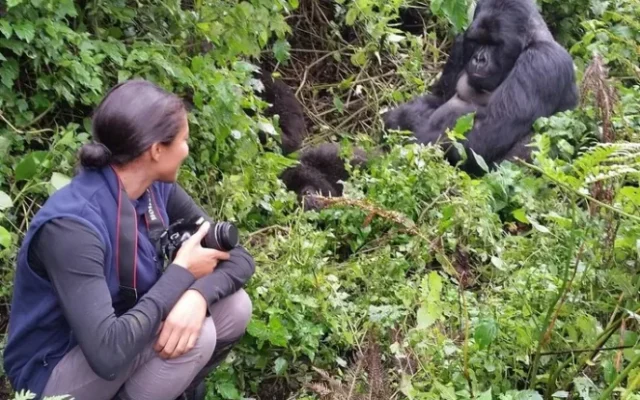
Often the first gorilla remains partly hidden by vegetation. A tracker may quietly point toward a dark shape. You look. Nothing. Then the animal moves. A face appears. After hours of following people who seemed able to interpret invisible signs, the entire tracking process suddenly makes sense.
Trackers Remain During the Encounter
Their work does not end when the gorillas are found. Gorillas often continue moving and feeding during the viewing period. Trackers help understand these movements and assist the ranger guide with positioning. If the family moves through vegetation, trackers may identify a practical route that allows the visitor group to maintain observation without unnecessarily disturbing the animals. They also help monitor gorilla behavior.
Their familiarity with the family is invaluable.
What Tourists Can Learn From Trackers
Ask questions when appropriate. Many trackers possess remarkable knowledge of gorilla behavior, plants, birds, forest ecology and individual animals. They may explain who a particular gorilla is, how old an individual is approximately, or how family relationships have changed. They can point out feeding signs you would otherwise walk past. This transforms the trek from a simple wildlife sighting into a lesson in rainforest ecology.
Tracking Is Also Conservation Work
Tourism is only one reason gorilla families are monitored. Regular observation helps conservation teams understand group composition, movements and health. Changes can be detected. Births become known. Injuries can be noticed.
Unusual behavior may attract attention. The continued presence of trained field teams therefore contributes to the broader conservation system surrounding mountain gorillas. Tourism revenue in turn helps support protected-area management and conservation.
Why Gorilla Tracking Feels So Different From a Game Drive
On a savannah safari, your guide may drive toward a pride of lions visible hundreds of meters away. Bwindi offers no such visibility. A gorilla can be fifty meters from you and remain completely invisible behind vegetation. Finding it requires interpretation rather than eyesight alone. That creates an unusual sense of discovery.
You follow trackers into forest where almost everything looks identical. Then subtle clues begin appearing. Fresh stems. Disturbed leaves. Footprints. Sounds. Suddenly the trackers slow down. You realize they know something you do not. Minutes later, a silverback emerges from behind the vegetation.
The People Behind Your Gorilla Encounter
When travelers describe gorilla trekking, the gorillas understandably dominate the story. But behind every successful encounter is an extraordinary network of people. Trackers enter the forest. Rangers guide tourists. Researchers and conservation staff monitor gorilla families.
Porters help visitors negotiate the terrain. Community relationships contribute to conservation around the forest boundary. Your one hour with gorillas depends on years of knowledge and daily work that most visitors never see.
How Trackers Find Mountain Gorillas
So how do trackers find mountain gorillas in Bwindi? They start with the family’s last known location. They inspect nesting sites. They follow feeding remains. They examine broken vegetation.
They look for footprints and dung. They interpret how fresh each sign is. They listen. They communicate. They use intimate knowledge of the forest, terrain and individual gorilla families.
And step by step, the clues become fresher until the gorillas are finally located. When you eventually see that first dark shape moving through Bwindi's vegetation, remember that the encounter did not happen by chance. Long before you raised your camera, someone had already been reading the rainforest.
 Read