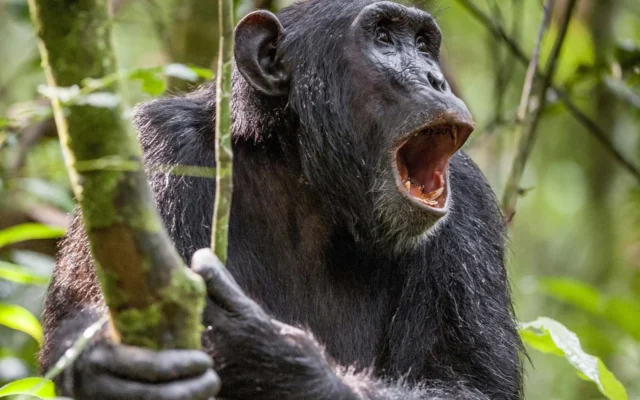
Few sights in an African rainforest are as captivating as baby chimpanzees clinging tightly to their mothers, peering curiously through the vegetation or attempting to imitate the behavior of older members of their community. They may look playful and carefree, but childhood is an extraordinarily important stage in a chimpanzee's life. Young chimpanzees have an enormous amount to learn.
They must understand what foods are safe to eat, where those foods can be found, how to move through complicated forest vegetation, which individuals are dominant, how to communicate, how to groom, when to remain quiet and how to behave within one of the most socially complex animal societies on Earth. They are not born knowing all of this.
Introduction
Instead, much of chimpanzee childhood is spent watching, experimenting, playing and learning from experienced members of the community—particularly their mothers. For travelers visiting chimpanzee habitats in Uganda, watching this learning process can become one of the most fascinating parts of a chimpanzee trekking experience.
A Baby Chimpanzee's Life Begins With Its Mother
A newborn chimpanzee is completely dependent on its mother. During the earliest stage of life, the infant clings closely to her body. The mother provides milk, warmth, protection and transport. As she moves through the forest, the baby travels with her. This means that from its first days, the infant is exposed to the daily rhythm of chimpanzee life.
It experiences feeding sites. It hears vocalizations. It watches social interactions. It encounters other members of the community. It learns the routes its mother follows through the forest. Initially, the infant may understand very little of what is happening around it. But observation begins immediately.
Why Chimpanzee Childhood Lasts So Long
Chimpanzees mature slowly compared with many mammals. This prolonged childhood is one of the reasons their behavior becomes so sophisticated. An animal living in a complex social community and using a wide variety of foods cannot simply rely on instinct for everything. Young chimpanzees need time to learn. They must gradually develop physical coordination while also acquiring enormous amounts of social and ecological knowledge.
This resembles human childhood in an important way. Both humans and chimpanzees spend unusually long periods dependent on adults while learning the skills needed for survival. That does not mean chimpanzees develop exactly like humans, but it highlights how important learning is in their lives.
The First Way Baby Chimpanzees Travel
Very young baby chimpanzees normally remain attached to their mothers. The ability to cling is critical. Chimpanzee mothers move through uneven forest environments, climb trees and travel substantial distances while searching for food. A tiny infant therefore needs to remain secure. As the baby grows stronger, its position while travelling can change. Eventually it becomes increasingly capable of moving independently. These transitions provide opportunities for the young chimpanzee to develop balance, coordination and strength. The forest is essentially its enormous natural playground and training ground.
Learning to Climb
Chimpanzees are excellent climbers. For adults, moving through trees can look effortless. For youngsters, however, climbing skills must develop over time. Young chimpanzees begin by experimenting close to their mothers. They climb small branches. They hang from vegetation. They practice balancing. They test different routes through trees. Mistakes happen. Youngsters may lose balance or choose awkward branches. Play allows them to develop these abilities without every movement being associated with an urgent survival requirement. Over time, their coordination improves dramatically. The clumsy infant gradually becomes an agile forest traveller.
Play Is Serious Learning
Visitors often interpret young chimpanzee play simply as entertainment. In reality, play has enormous developmental value. Young chimpanzees chase one another. They wrestle. They climb. They swing from branches. They grab objects. They tumble through vegetation. Through these activities they develop physical strength, coordination and confidence. But play is not only physical. It is also social. A young chimpanzee needs to understand when another individual wants to play, when play has become too rough and when it should stop. This requires communication. Play therefore gives youngsters opportunities to practice reading gestures, facial expressions and body language.
Mothers Are the Most Important Teachers
Chimpanzee mothers do not necessarily teach through formal lessons in the way humans might imagine. Much learning occurs because infants remain close to them for years. A baby sees what its mother eats. It watches where she travels. It observes how she responds to different individuals. It notices which foods she ignores. It sees how she reacts when danger appears. This constant exposure creates thousands of learning opportunities. Mothers provide the social and ecological foundation from which young chimpanzees begin understanding their world.
Learning What to Eat
A tropical forest contains an extraordinary number of plants. Not everything is useful as food. A young chimpanzee must learn which fruits, leaves, seeds and other materials are worth eating. This is not a trivial task. Food availability also changes with seasons. A fruiting tree that provides abundant food at one time may offer nothing several months later. By accompanying experienced adults, youngsters gradually learn where important food resources occur. They watch what others select. They smell and taste objects. They experiment. Over time, they develop the knowledge necessary to survive within their particular forest environment.
Learning Where Food Can Be Found
Knowing what to eat is only part of the challenge. Chimpanzees also need to know where food is located. A forest is enormous from the perspective of an individual chimpanzee. Important trees may be scattered across a large home range. Adults need extensive spatial memory to navigate efficiently between feeding locations. Young chimpanzees begin building this mental map by travelling with their mothers. Day after day, year after year, they experience routes through the forest. Eventually those routes become part of their own knowledge.
Learning From Other Chimpanzees
Mothers are critical, but they are not the only teachers. A chimpanzee community contains many individuals. Youngsters observe siblings, older juveniles, adult females and adult males. Each interaction provides information. A youngster may discover who is tolerant and who is not. It may learn which adults allow play nearby. It gradually becomes familiar with dominance relationships. This knowledge becomes essential as the chimpanzee grows older and increasingly interacts independently. Chimpanzee survival is not simply about finding food. It is also about understanding society.
Learning Chimpanzee Etiquette
Chimpanzee communities have complicated social relationships. Some individuals are dominant. Others are subordinate. Friendships and alliances can influence interactions. Young chimpanzees slowly learn how to navigate this structure. Approaching the wrong individual in the wrong manner may produce an unpleasant response. Behaving appropriately around a high-ranking chimpanzee can be important. Grooming relationships matter. Communication matters. Experience teaches youngsters how to behave. This process continues for years.
Learning How to Communicate
Chimpanzees communicate through vocalizations, gestures, facial expressions, posture and touch. A baby chimpanzee grows up surrounded by these signals. It hears pant-hoots. It experiences screams. It observes gestures. It feels grooming and physical contact. It sees how other chimpanzees respond to different signals. Youngsters gradually learn both how to produce communication and how to interpret it. Play is particularly useful. A youngster may invite another chimpanzee to play through movements or gestures. If the other individual responds, communication has succeeded.
Learning Through Imitation
One of the most fascinating aspects of chimpanzee development is the importance of observation and imitation. Young chimpanzees pay close attention to what adults do. When they see an experienced individual manipulating an object or solving a problem, they may attempt similar actions. Initially their efforts may be unsuccessful. But repetition matters. The youngster experiments. It changes its technique. Eventually it becomes more competent. This form of social learning helps transmit behaviors between generations.
Tool Use and Chimpanzee Culture
Different chimpanzee populations have been observed using objects in distinctive ways. These behaviors have become especially interesting to researchers because some appear to be learned socially rather than being purely instinctive. Young chimpanzees may spend considerable time watching adults perform particular actions. They may then experiment themselves. Learning can take years. The youngster must understand not only which object to use but also how and when to use it. This illustrates just how sophisticated chimpanzee learning can be.
Young Chimpanzees Make Mistakes
Learning is not perfect. Like human children, young chimpanzees experiment. They choose unstable branches. They play too roughly. They mishandle objects. They may fail repeatedly when attempting a task. These mistakes are part of development. Every unsuccessful attempt produces information. A branch that bends too far teaches something about support. A social interaction that produces an angry response teaches something about boundaries. A failed attempt to manipulate food teaches something about technique. Experience gradually produces competence.
The Importance of Siblings
Older siblings can influence a young chimpanzee’s development. They may provide play partners and social opportunities. Watching siblings also gives infants examples of behavior from individuals closer to their own developmental stage. Family relationships can therefore extend beyond the mother-infant bond. Young chimpanzees grow up inside a network of relationships that gradually becomes more important as they become independent.
What Happens If a Mother Has Another Baby?
A young chimpanzee’s relationship with its mother changes gradually. As it grows, it becomes increasingly independent. Eventually, the mother may have another infant. The older youngster must adjust. It may no longer receive the same level of physical attention. This transition forms part of growing up. The youngster increasingly travels, feeds and interacts without constant maternal assistance. However, relationships between mothers and offspring can remain important long after infancy ends.
Young Males and Young Females May Follow Different Paths
As chimpanzees mature, males and females can develop different social patterns. Young males become increasingly involved with adult male society. They need to understand dominance relationships and alliances. Females may eventually establish their own reproductive lives within or, depending on the community, beyond the group in which they were raised. These later differences develop gradually. During infancy, both sexes depend heavily on mothers and benefit from prolonged learning.
What Baby Chimpanzees Teach Scientists
Young chimpanzees are particularly valuable to researchers studying learning and development. Scientists can observe how behaviors appear. Did the infant discover something independently? Did it watch its mother first? Does it copy particular individuals?
How long does it take to master a task? Do youngsters spend more time observing certain community members? Long-term studies can reveal how knowledge moves between generations. This helps scientists understand not only chimpanzees but broader questions about intelligence, learning and social evolution.
Seeing Baby Chimpanzees During Chimpanzee Trekking
Visitors trekking chimpanzees in Uganda may encounter mothers carrying infants or youngsters playing among vegetation. There is no guarantee because chimpanzee communities are wild and constantly moving. When young chimpanzees are present, however, they often become irresistible subjects for observation. Their curiosity can be remarkable. A youngster may climb awkwardly while an adult moves effortlessly nearby.
Another may repeatedly attempt to initiate play. Watching these behaviors makes it easy to appreciate that development is taking place continuously.
Photographing Baby Chimpanzees
Baby chimpanzees can be challenging photographic subjects. They rarely stay where photographers would like them to stay. They may remain partially hidden against their mother’s body. When they become active, they can move rapidly through vegetation. A zoom lens can be particularly useful because the distance between photographer and subject may change constantly.
More importantly, visitors should never attempt to move closer simply to photograph a youngster. Follow ranger instructions at all times. Animal welfare comes before photography.
Why Chimpanzee Habitats Matter for Youngsters
Protecting chimpanzees means protecting the environment in which learning occurs. A baby chimpanzee does not merely require its mother. It requires forest. It needs fruiting trees. It needs safe routes through habitat.
It needs other chimpanzees. It needs a functioning community from which social information can be learned. When forests become fragmented, the effects therefore extend beyond simple loss of space. The entire ecological and social environment supporting chimpanzee development can be affected.
Chimpanzee Trekking and Conservation
Responsible chimpanzee tourism can help visitors appreciate the complexity of these animals. Seeing an infant clinging to its mother produces a very different emotional connection from reading about chimpanzees in a book. Visitors see that chimpanzees are individuals. They see families and relationships. They witness learning and communication.
That experience can create a stronger appreciation for why Uganda's forests deserve protection.
Combine Chimpanzees and Gorillas in Uganda
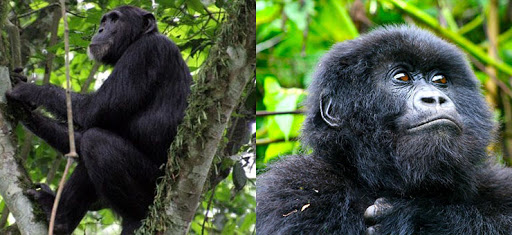
Travelers particularly interested in primates can combine chimpanzee trekking with mountain gorilla trekking. Kibale National Park is Uganda’s best-known chimpanzee trekking destination, while Bwindi Impenetrable National Park and Mgahinga Gorilla National Park provide opportunities for gorilla trekking. The contrast is fascinating. Chimpanzees are often energetic and vocal. Gorilla encounters can feel quieter and more intimate.
Young animals in both species, however, provide extraordinary opportunities to observe learning, play and family relationships.
Final Thoughts on Baby Chimpanzees
Baby chimpanzees may look adorable, but their childhood represents something much more important than cuteness. They are apprentices in an extraordinarily complicated forest society. They learn what to eat. They learn where food grows. They learn how to climb.
They learn who is dominant. They learn how to communicate. They learn through play, observation, mistakes and imitation. For years, their mothers provide protection and an invaluable window into adult chimpanzee life. Eventually, the dependent infant becomes an independent member of the community carrying knowledge acquired through thousands of experiences.
Watching that process in Uganda's forests offers one of the most fascinating insights into the intelligence and social complexity of our closest living relatives.

 Read