The arrival of a new mountain gorilla is one of the most encouraging events for anyone involved in gorilla conservation. A baby gorilla birth adds another member to a population whose survival depends on decades of protection, habitat conservation, monitoring and cooperation with communities living around gorilla habitats. But what actually happens when a baby gorilla is born?
Unlike births in zoos, a wild mountain gorilla birth generally takes place without a team of people surrounding the mother. The female remains within her natural social environment, and researchers, trackers and veterinarians normally observe from an appropriate distance. After birth, the tiny infant enters a world dominated by its mother. It clings to her. It nurses.
Introduction
It travels wherever she travels. And during the following months and years, it gradually transforms from a completely dependent newborn into an energetic young gorilla exploring the forest.
How Big Is a Newborn Gorilla?
Considering the enormous size of an adult silverback, newborn gorillas are remarkably small. A baby begins life much closer in size to a human newborn than most visitors expect. Its body will eventually grow dramatically, particularly if the infant is male and develops into an adult silverback. But at birth, it is tiny and vulnerable. The baby’s small size emphasizes just how important maternal care is during the earliest stage.
Where Does a Gorilla Give Birth?
Mountain gorillas give birth within their natural forest habitat. There is no maternity room. The female remains part of her gorilla family. Because births can occur away from researchers or trackers, the exact moment is not always directly witnessed. Monitoring teams may discover that a female has delivered when they next locate the family and see the newborn with her. This can turn an ordinary monitoring day into an exciting conservation announcement.
Does the Mother Need Help During Birth?
Most wild gorilla births proceed naturally without human assistance. The objective of conservation is not to convert wild gorillas into animals dependent on continuous veterinary management. Veterinary intervention is reserved for circumstances where conservation protocols justify action. Mountain gorillas remain wild animals. Their natural reproduction is allowed to occur with minimal human interference.
The Newborn Immediately Depends on Its Mother
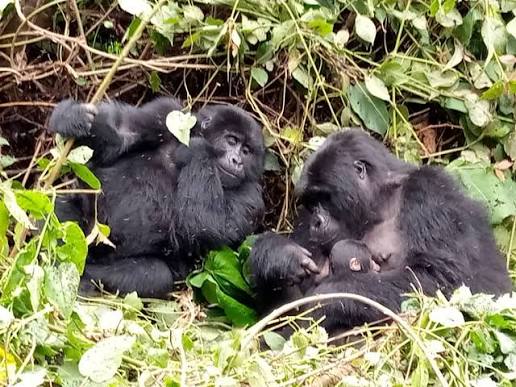
After birth, the infant’s relationship with its mother becomes critical. The baby is not capable of independently traveling through mountainous rainforest. It must remain attached to her. During the earliest months, the infant generally clings to its mother’s front. She carries it while feeding, resting and moving with the family. The youngster receives warmth, protection and access to milk through almost constant contact.
How Does the Baby Hold On?
Young gorillas possess a strong grasping instinct. The infant grips the mother’s hair and body while being supported by her. As it develops, its strength and coordination improve. Eventually, an older infant can ride more confidently and later move onto its mother’s back. Visitors sometimes wonder how a baby stays attached while its mother moves through steep vegetation. The answer becomes obvious when you watch closely. Even a small infant is built for a life that involves gripping, climbing and moving through a forest environment.
When Does a Baby Gorilla Start Nursing?
Nursing begins very early. The mother’s milk provides the newborn’s essential nutrition. During the first part of life, the baby depends heavily on nursing. Later, it begins experimenting with the vegetation eaten by older gorillas. The transition toward solid food develops gradually. There is no sudden day when a baby stops being dependent and becomes an independent feeder.
What Does the Silverback Do When a Baby Is Born?
The dominant silverback does not normally become the primary caregiver in the same way the mother does. However, the newborn is born into a social family in which the silverback can play an important protective role. The male may remain nearby as the family continues its normal routine. As the infant grows older, interactions with the silverback may increase. Youngsters can become surprisingly comfortable around enormous adult males.
A juvenile may eventually play near him, approach him or sit close to him.
How Does the Rest of the Family React?
A new infant becomes another member of an existing social network. Other gorillas may show interest, particularly as the baby becomes more visible and active. Older siblings and juveniles can sometimes be curious. However, the mother controls access closely during the earliest stage. The newborn’s immediate relationship remains overwhelmingly centered on her. As the youngster grows, its social world gradually expands.
Why the First Months Are So Important
A newborn is particularly vulnerable. It depends on its mother for almost everything. Successful nursing, maternal care and freedom from serious illness are essential. Conservation teams therefore pay close attention to known infants during routine monitoring. They observe the mother and infant from a responsible distance and note whether the youngster appears to be developing normally.
Do Gorilla Mothers Carry Babies Everywhere?
Essentially, yes, during the stage when the infant cannot travel independently. The mother still needs to feed and move with the family. The baby therefore travels with her. Imagine carrying an infant while climbing steep forested slopes and pushing through vegetation every day. For a mountain gorilla mother, this is normal. Her body is adapted to the environment, and the infant gradually becomes increasingly capable of holding on.
When Can a Baby Ride on Its Mother’s Back?
As the infant grows stronger and gains coordination, its preferred riding position gradually changes. An older infant may increasingly travel on the mother’s back. This gives the youngster a different view of the world and reflects increasing physical development. Eventually, the baby starts getting off more frequently to explore. These stages are gradual. Every infant develops as an individual rather than following an exact tourist-friendly schedule.
The First Attempts at Exploration
One of the most entertaining developmental stages begins when an infant realizes the forest is available for exploration. At first, it remains extremely close to its mother. Then it stretches toward vegetation. It may crawl a short distance. It begins attempting small climbs. Every excursion is an opportunity to develop muscles, balance and confidence. The mother remains the secure base. If the youngster becomes uncertain, she is close enough to provide safety.
Baby Gorillas Learn by Watching
A young mountain gorilla is surrounded by teachers even though no one gives formal lessons. It watches its mother select food. It observes older juveniles climbing. It hears adult vocalizations. It sees interactions with the silverback. It watches other gorillas respond to gestures and social situations. Much of gorilla education happens through participation in daily family life.
Play Begins to Shape Development
As the infant gets older, play becomes increasingly important. Young gorillas are among the most entertaining animals visitors can watch during a gorilla trek. They may chase each other through vegetation. They climb. They wrestle. They roll. They initiate playful interactions repeatedly. Play builds physical ability and teaches social boundaries. A youngster learns how strongly it can push another gorilla and how to recognize when a play partner wants to stop.
What Happens If the Baby Is Male?
A newborn male begins life no differently from other infants in terms of dependence on maternal care. But his future could eventually look very different. Over many years, he grows larger. As he reaches adolescence and maturity, his relationship with the family can change. Eventually, he may develop the distinctive silver coloration associated with mature males. Depending on social circumstances, he might remain within a multi-male family, disperse or potentially establish his own group. The tiny baby clinging to its mother today could therefore become a massive silverback in the future.
What Happens If the Baby Is Female?
A young female also remains within the family throughout childhood. As she matures, she may eventually transfer between gorilla groups as part of natural social dynamics. Female movement plays an important role in how gorilla families form and change. Her future reproductive success can eventually contribute another generation to the mountain gorilla population.
Why Every Gorilla Birth Is Important
Mountain gorillas reproduce relatively slowly. Females generally invest years in raising each infant. This means populations cannot increase rapidly. A successful baby gorilla birth is therefore important for long-term conservation. It is especially meaningful when infants survive their vulnerable early years and eventually reach maturity.
Each newborn represents potential continuity for future generations.
How Do Conservation Teams Know a Baby Has Been Born?
Habituated gorilla families are monitored regularly. Trackers and researchers know the identities and reproductive histories of individual females. Pregnancy may be suspected or observed before the birth. When teams later see a mother carrying a newborn, the birth can be recorded and monitored. Information about births, deaths, transfers and group changes contributes to long-term understanding of the population.
Does the Baby Receive a Name?
Known gorillas often receive names that help researchers, trackers, guides and conservation teams identify individuals. Naming practices vary according to the conservation area and circumstances. Names can become particularly meaningful because many gorillas are monitored throughout their lives. A youngster first recorded as a newborn may eventually become an adult whose entire life history is familiar to conservation teams.
Can Tourists See Newborn Gorillas?
Potentially, yes, if a habituated family currently has a newborn and that family is allocated to the trekking group. But no ethical tour operator can guarantee that you will see a baby. Gorilla families change naturally. Births occur at different times. Infants grow.
And permit allocation depends on trekking arrangements. The best approach is to appreciate whichever family you encounter.
Why You Must Never Approach a Baby Gorilla
A baby gorilla can appear irresistibly approachable. It is not. This is a wild animal living within a protected family. Visitors must respect the required viewing distance and all instructions from rangers. Never move toward a baby because you want a close photograph. Never touch one. Never attempt to attract its attention. And never place yourself between a mother and her youngster. If an infant approaches independently, remain calm and follow your ranger’s directions.
Disease Protection Is Especially Important
Mountain gorillas share enough biological similarity with humans that infectious disease transmission is a significant concern. Infants may be particularly vulnerable. Health regulations surrounding gorilla tourism therefore have conservation importance. Visitors who are ill should communicate openly with their safari guide and relevant park staff. Ignoring illness because you do not want to miss a trek can place wildlife at risk. Responsible tourism prioritizes the gorillas.
A Baby Changes Constantly
One of the advantages of long-term monitoring is seeing how rapidly an infant changes. At first, perhaps only its tiny face is visible against its mother’s chest. Months later, it is peering over her back. Then it begins climbing nearby. Later it becomes an energetic juvenile racing through vegetation. Eventually, it becomes an independent young gorilla. For trackers who know individuals over years, these developmental stories make every family unique.
Births Strengthen the Story of Gorilla Conservation
Mountain gorilla conservation has required sustained protection across national borders, protected areas and surrounding communities. Every newborn provides a visible reminder of what that work seeks to preserve. Tourists understandably celebrate babies because they are adorable. Conservationists see something additional: another member of a population whose future depends on continued protection.
Photographing a Baby Gorilla Responsibly
Newborns can be challenging to photograph because mothers often hold them close. Do not attempt to change the situation. Wait. Observe. Use available natural light and respect restrictions on flash. Sometimes the best photograph is simply a tiny face looking through its mother’s arms. At other times, vegetation may block the view completely. Remember that wildlife does not exist to provide perfect photographs.
What Makes Seeing a Baby So Emotional?
Part of the emotion comes from familiarity. Humans recognize dependence between a mother and infant. We understand the vulnerability of a tiny baby surrounded by large adults. We recognize curiosity as the infant begins exploring. These similarities can create a powerful sense of connection. But it is important not to forget that gorillas have their own natural social systems. We should appreciate them without turning every behavior into a human story.
From Newborn to Juvenile
The transformation occurs gradually. A newborn clings. An infant begins exploring. A youngster plays. A juvenile becomes increasingly independent. Social learning continues throughout the process. The mother remains important even as constant physical dependence decreases. By the time the young gorilla begins functioning independently, years of learning have already shaped its behavior.
Final Thoughts
A baby gorilla birth begins one of the longest and most fascinating childhoods in the animal world. The newborn enters life almost completely dependent on its mother. It clings to her body, nurses and travels wherever she goes. Over the following months, it becomes stronger. It begins riding on her back.
It explores nearby vegetation. It experiments with food. It interacts with other members of the family. Eventually, play becomes an important part of development and the youngster’s social world expands. For conservationists, each birth is an important addition to the mountain gorilla population.
For visitors fortunate enough to see a newborn in Bwindi or Mgahinga, it can be a deeply memorable moment. Look carefully at the tiny gorilla hidden against its mother’s body. You are not simply seeing a cute baby. You are watching the beginning of another mountain gorilla life.
 Read