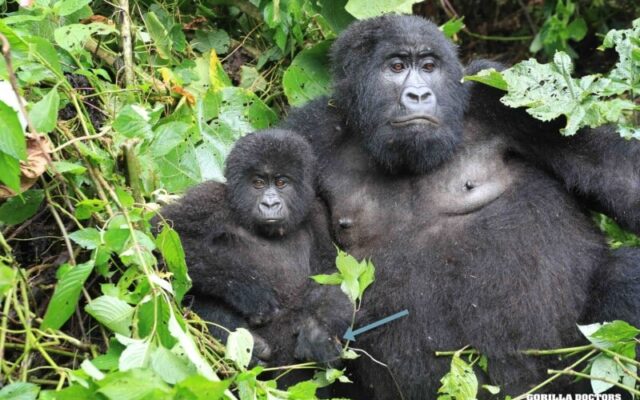
Two mature silverback gorillas are among the most physically powerful primates in Africa. When rival males encounter each other, the possibility of conflict can therefore be dramatic. But what happens when silverbacks fight? The first thing to understand is that serious physical combat is not automatically the first response.
Fighting is dangerous even for an extremely strong gorilla. A male that suffers a severe injury may struggle to feed, travel, defend himself or protect his family. For this reason, gorillas possess an impressive range of displays and communication behaviors that can allow rivals to assess each other before escalating to physical confrontation.
Introduction
When fighting does happen, however, the encounter can be intense and may affect not only the two males but the entire social structure of a gorilla family.
Why Would Two Silverbacks Confront Each Other?
Competition between males can arise for several reasons. One of the most important is access to females and family groups. A solitary male may attempt to interact with or attract females from an established family. A male within a multi-male group may experience changing social relationships as he matures. Groups may also encounter one another while moving through overlapping or neighboring ranges.
Not every meeting results in violence. Context matters enormously.
Displays Usually Come Before Serious Fighting
Imagine the cost of immediately attacking every rival you meet. For a wild animal, that strategy would be dangerous. A better strategy is to communicate first. Silverbacks can use posture, movement, vocalizations and chest beating to advertise their presence and physical condition. A male may appear larger and more imposing during a display.
He can communicate willingness to defend himself without immediately making physical contact. If the rival decides that confrontation is not worthwhile, a serious fight may be avoided.
Why Chest Beating Matters
Chest beating is one of the most recognizable gorilla displays. The sound can travel through dense forest vegetation. It may communicate information about the displaying male, including aspects related to physical size. This means a rival may receive useful information even before approaching closely. A chest beat can essentially announce: “There is a mature male here.” For a rival, that information matters. The goal of communication is not necessarily to start a fight. It may help prevent one.
What Does a Silverback Display Look Like?
A full display can involve multiple behaviors. Depending on circumstances, a silverback may make vocalizations, adopt an imposing posture, move rapidly, beat his chest or interact forcefully with vegetation. The exact sequence varies. Movies tend to portray gorillas as constantly performing exaggerated aggressive displays. Wild gorillas are considerably more nuanced. A display needs to be interpreted within the broader situation.
When Does a Fight Become Physical?
If displays do not resolve the confrontation, males may make physical contact. At this point, their enormous strength, powerful arms, large bodies and substantial canine teeth make the encounter potentially dangerous. A serious fight can result in wounds. This is precisely why avoiding unnecessary physical combat has evolutionary value. Winning a confrontation is not particularly useful if the winner becomes badly injured in the process.
Are Silverback Fights Common During Gorilla Trekking?
No. Visitors should not book a gorilla safari expecting to watch silverbacks fight. Most tourist encounters involve gorillas feeding, resting, moving and interacting socially. Serious fights are naturally occurring events rather than scheduled spectacles. If unusual behavior occurs during a trek, ranger instructions become especially important.
Tourists should never attempt to move closer to a conflict for dramatic photographs.
What Happens to the Family During a Conflict?
A confrontation between males is not isolated from the rest of gorilla society. Females and young gorillas may be affected by changes in leadership or group structure. If an outside male successfully disrupts an established group, females may make decisions about whether to remain, transfer or associate differently. In multi-male groups, relationships between males can also influence stability.
This is why conservationists study entire gorilla families rather than treating individual silverbacks as isolated animals.
Can Two Silverbacks Live Together Peacefully?
Yes. The presence of more than one adult male does not automatically produce constant fighting. Some mountain gorilla families contain multiple silverbacks. A dominant male may occupy the highest social position while other mature males remain within the group. They can travel, feed and rest in the same family.
Relationships between males are shaped by history and social structure. This is an important reminder that gorilla society cannot be reduced to the phrase “two males must fight.”
Brothers Can Remain Together
In some circumstances, males that grew up together may continue sharing a group after reaching maturity. Established relationships can influence how they interact. One may become dominant while another remains subordinate. Their positions can change as individuals age and circumstances develop. Such relationships are one of the reasons long-term studies of known gorilla families are so informative. Researchers can understand not only what a gorilla is doing today, but also the history between the individuals involved.
What Happens When a Younger Silverback Becomes Stronger?
A younger male within a group may gradually become larger, more experienced and more socially influential. This does not guarantee an immediate challenge. Dominance can change in ways that are far more subtle than a single decisive fight. Relationships evolve. An older male may lose influence.
A younger male may increasingly take on important roles. Or the group may continue functioning with several mature males. Each family has its own history.
Can a Silverback Be Seriously Injured?
Yes. Although gorillas possess remarkable physical strength, they are not invulnerable. Bites and other injuries sustained during serious fights can be significant. Wildlife veterinarians and monitoring teams may become aware of injuries through routine observation of habituated families. Intervention decisions depend on conservation protocols and the specific circumstances.
The goal of gorilla conservation is not to prevent every natural conflict. These are wild animals with natural social lives.
Natural Behavior Versus Human-Caused Problems
This distinction is extremely important. A naturally occurring confrontation between wild gorillas is part of gorilla ecology. Conservation teams generally do not attempt to eliminate normal competition simply because it appears violent to human observers. Human-caused threats are different. Snares, habitat disturbance, disease transmission and other anthropogenic risks are conservation concerns that require management.
Responsible conservation allows gorillas to remain wild while reducing threats created by people.
How Powerful Is a Fighting Silverback?
Extremely powerful. Adult males possess large, heavily muscled upper bodies, powerful jaws and considerable agility. However, claims that a gorilla is precisely five, ten or twenty times stronger than a human should be treated cautiously. Strength cannot be reduced to one universal number. What matters in a fight between gorillas is the combination of size, strength, experience, motivation and social circumstances.
Is the Biggest Silverback Always the Winner?
Not necessarily. Physical size provides obvious advantages, but animal conflicts are more complicated. Age, experience, condition, confidence and the context of the confrontation all matter. A male may also avoid escalating when the potential cost is too high. This again demonstrates why displays are so valuable.
Animals can assess rivals without testing every difference through direct combat.
What Should Tourists Do If Silverbacks Become Agitated?
Listen immediately to your ranger. Do not make sudden movements. Do not run. Do not imitate chest beating or vocalizations. Do not approach for a photograph.
Do not attempt to position yourself between gorillas. Your trekking team has experience interpreting behavior and will determine how visitors should respond. The fact that gorilla trekking is carefully guided is especially important during unusual or highly energetic situations.
Why Running Is a Bad Response
A frightened visitor’s instinct may be to move away quickly. But sudden movement can make a situation less predictable. Rangers provide instructions appropriate to gorilla behavior and the position of the trekking group. Remaining calm is therefore essential. Remember that habituated gorillas regularly experience controlled visits. The presence of tourists does not mean the animals have stopped being wild, but well-managed encounters are designed to minimize disruption.
Could a Silverback Fight to Protect Infants?
A mature male can play a major defensive role within the family. When the group is threatened by another male, his response can help protect females and youngsters. The social consequences of a takeover or major group disruption can be serious, which gives established males strong reasons to defend their position. This protective function is part of why silverbacks are such important figures within gorilla families.
Why Do Gorillas Have Large Canine Teeth?
Adult male gorillas develop impressive canine teeth. They are not primarily predators; gorillas consume predominantly plant-based diets. The canines nevertheless have importance in social and defensive contexts. Displaying the teeth can be intimidating, and they can cause significant injury during physical conflict. This provides yet another reason why avoiding full combat can benefit both males.
What Happens After a Fight?
The consequences depend on the severity and outcome. One male may retreat. A family may remain together. Social relationships may change. Females may transfer under some circumstances.
Injured gorillas may require monitoring. The dominant position within a family may also change. There is no single outcome that follows every confrontation.
Long-Term Monitoring Reveals the Real Story
Tourists see a gorilla family for only a short regulated period. Trackers, rangers and researchers can observe changes across much longer periods. They know family histories. They may recognize when a younger male is maturing, when relationships between silverbacks are changing or when females transfer. This long-term information is crucial for understanding why a confrontation happened and what it means.
Why Silverback Conflict Is Not Entertainment
A fight may sound exciting when described online, but for the gorillas involved it is a serious natural event. Responsible wildlife tourism should not encourage guides to provoke displays or move visitors toward dangerous situations simply to produce spectacular video. The privilege of gorilla trekking comes from observing wild behavior respectfully. Sometimes that behavior is quiet. Sometimes it is playful.
Occasionally it may be intense. The tourist’s role remains the same: observe without interfering.
Most Silverback Interactions Are Less Dramatic
It is useful to finish with this perspective. Silverbacks are not constantly fighting. A mature male may spend a large part of his day eating and resting. Even families with multiple adult males can remain socially stable. Communication allows many disagreements to be resolved without dangerous combat.
The dramatic image of two enormous males battling through the forest represents only one possible outcome within a much larger social system.
Final Thoughts
So, what happens when silverbacks fight? Usually, the story begins before physical contact. Displays, chest beats, vocalizations and body posture allow males to communicate and assess one another. These signals may prevent a serious confrontation altogether.
When physical fighting does occur, the strength and canine teeth of mature males make it potentially dangerous. Injuries can occur, and the outcome may influence leadership, female movements and the wider stability of a family. Yet the most interesting lesson is that strength does not always need to be used. A silverback’s ability to communicate power may prevent him from having to prove it.
That balance between enormous physical strength, social intelligence and communication is one of the many reasons mountain gorillas are such fascinating animals to observe in Uganda’s forests.
#26 — How Mountain Gorillas Communicate: Sounds, Gestures and Body Language
Category: Gorilla Stories SEO Title: How Mountain Gorillas Communicate: Sounds and Body Language Meta Description: Discover how mountain gorillas communicate through grunts, chest beats, facial expressions, posture, touch, gestures, and other social signals. Focus Keyphrase: how mountain gorillas communicate Gorilla trekking can initially seem quiet.
You walk through the forest, locate a family and watch individuals feeding among dense vegetation. There may be no roaring, dramatic fighting or constant noise. But look and listen more carefully. Communication is happening everywhere.
A mother shifts her body when an infant approaches. A juvenile invites another youngster to play. A silverback gives a low vocalization. Two gorillas groom each other. An individual changes posture as another passes. Somewhere in the vegetation, a chest beat suddenly echoes through the forest.
Understanding how mountain gorillas communicate transforms the experience. Gorillas use a rich combination of sounds, facial expressions, gestures, body posture, movement and touch. Communication helps maintain relationships, coordinate activities, warn others, manage tension, encourage play and keep gorilla families functioning. They may not speak in sentences like humans, but their social lives are far from silent.
Mountain Gorillas Are Highly Social
Mountain gorillas generally live in family groups rather than spending their lives alone. A family may contain a dominant silverback, other mature males, females, juveniles and infants. Living socially requires constant exchange of information. Who wants to move? Who is uncomfortable?
Who wants to play? Where is an infant’s mother? Is another gorilla approaching aggressively or peacefully? Has a silverback detected something unusual? Communication makes all of these interactions easier.
Gorilla Communication Is More Than Vocalization
When humans think about communication, we naturally focus on sound. But gorilla communication is multimodal. They use combinations of:
A gesture that means one thing during playful interaction could appear different in a tense situation. Context is essential. This is one reason experienced researchers and trackers learn by observing the same gorillas repeatedly.
Gorillas Have a Range of Vocalizations
Mountain gorillas produce different sounds during daily life. Some are quiet enough that tourists may barely notice them. Others can be much more obvious. Vocalizations can communicate content related to contact, reassurance, excitement, alarm or social tension. The precise interpretation depends on the sound and situation.
Low-frequency grunts are among the sounds visitors may hear while gorillas feed and move around one another. These relatively subtle vocalizations can help maintain peaceful social contact.
The Famous Gorilla Grunt
Guides sometimes describe certain low gorilla vocalizations in simple terms for visitors. You may hear a ranger produce a soft sound intended to communicate calm presence to habituated gorillas. Tourists should not independently attempt to imitate every gorilla sound they hear. Your ranger understands the encounter and knows when particular behavior is appropriate. The important point is that not all gorilla vocalizations are warnings. Many occur during completely peaceful interactions.
Chest Beating Is a Long-Distance Signal
Perhaps the most spectacular example of how mountain gorillas communicate is chest beating. A mature silverback can produce a powerful series of beats with cupped hands. The sound can carry through dense vegetation. That matters in a rainforest where visual contact is often limited. A gorilla may therefore communicate presence and information to individuals that cannot see him clearly.
Chest beating can form part of display behavior and may communicate characteristics associated with the male’s size.
Is Chest Beating Always Aggressive?
No. This is one of the most common misunderstandings about gorillas. Context determines meaning. Chest beating can occur during displays associated with competition, but it is not equivalent to saying, “I am about to attack.” Young gorillas may also perform chest-beating behavior during play or development. A juvenile’s enthusiastic little display can look completely different from that of an enormous adult silverback.
Facial Expressions Matter
Gorillas also communicate visually. Their faces can convey information through the position of the mouth, lips, eyes and other features. Humans naturally try to interpret animal facial expressions through human emotional categories, but this can be misleading. A facial movement that looks like a human smile may not carry the same meaning. This is why tourists should avoid assuming they can interpret every expression correctly.
Ranger guidance and behavioral context matter.
Body Posture Sends Messages
How a gorilla positions its body can communicate just as strongly as a sound. An animal may make itself appear larger during a display. A relaxed individual may sit or lie comfortably near family members. A youngster preparing to play can use body movements that encourage a response from another juvenile. A silverback may reposition himself when another gorilla approaches.
These movements are part of continuous social communication.
Gestures Are an Important Part of Gorilla Life
Great apes use many deliberate gestures. A gorilla may reach, touch, push, move or position part of its body in ways that influence another individual. Young gorillas are especially interesting to watch because play involves extensive nonverbal communication. A juvenile needs to signal that wrestling or chasing is playful rather than truly aggressive. Partners also need to respond appropriately.
This back-and-forth interaction develops social skills.
Touch Creates and Maintains Social Bonds
Physical contact is important within gorilla families. Mothers hold infants. Young gorillas climb onto their mothers. Individuals may sit close together. Grooming involves careful physical contact.
Youngsters wrestle during play. Touch can provide reassurance and reinforce social relationships. For visitors, some of the most emotionally powerful scenes involve gentle contact rather than dramatic displays.
Mothers and Infants Communicate Constantly
A gorilla infant begins learning communication from the earliest stages of life. Initially, it is physically dependent on its mother. The mother responds to movement, distress and feeding needs. As the infant becomes more mobile, interactions grow increasingly complex. The youngster begins exploring, playing and interacting with other family members.
It learns which behaviors produce responses. This gradual social education is critical for development.
Play Is a Communication Classroom
Watch young mountain gorillas for long enough and you will probably see play. They may wrestle. They chase. They climb. They roll across vegetation.
They approach one another repeatedly. Play teaches young gorillas how hard they can push, when another individual has had enough and how to interpret social signals. It is one of the ways young animals prepare for increasingly complex adult relationships.
Silverbacks Communicate Leadership Quietly
A dominant silverback does not need to chest-beat every few minutes. Much of his influence can be subtle. He begins moving toward another feeding area. Family members gradually travel in the same direction. He changes position during a social disagreement.
Another gorilla responds. He makes a vocalization and the behavior around him changes. To an inexperienced tourist, nothing dramatic has happened. To someone familiar with the family, communication may have been obvious.
How Gorillas Communicate During Conflict
Not every disagreement becomes a fight. Gorillas can use displays, posture, facial expressions and vocalizations before physical confrontation occurs. This ability has an important benefit. Fighting is dangerous. If an animal can convince a rival to retreat through communication, both may avoid injury.
A large silverback’s chest beat or imposing posture can therefore function partly as a way of advertising physical power without immediately using it.
Gorillas Communicate Across Dense Vegetation
Bwindi Impenetrable National Park helps explain why sound is so useful. Visibility can be restricted by vegetation. Family members feeding a short distance apart may not always have perfect visual contact. Vocal communication allows individuals to remain aware of others. The forest itself shapes how communication works.
This becomes much easier to appreciate when you are physically standing inside Bwindi.
Do Gorillas Have a Language?
This depends on what we mean by “language.” Gorillas possess sophisticated communication systems, but scientists generally distinguish animal communication from the highly generative language abilities of humans. Gorilla signals can nevertheless convey important information and support complex social interactions. They do not need human grammar to maintain relationships, communicate emotional states or coordinate social behavior.
Calling their system “simple” would underestimate the complexity visitors can observe.
How Rangers Interpret Gorilla Behavior
Rangers and trackers develop knowledge through training and repeated observation. A ranger who spends extensive time around habituated gorilla families recognizes patterns that a first-time visitor may miss. This can help explain why a gorilla suddenly changed posture, why a youngster made a particular movement or why the group responded to a silverback’s vocalization. During your trek, listen to these explanations.
They turn a wildlife sighting into a lesson in primate behavior.
Why Tourists Should Not Copy Gorilla Signals
Watching communication can tempt visitors to participate. Do not. You should never beat your chest at a silverback, deliberately make threatening gestures or imitate unknown vocalizations simply to see what response you receive. The purpose of gorilla trekking is observation. Provoking a wild animal for a photograph or video is irresponsible.
Follow the ranger’s instructions and allow the gorillas to communicate with one another naturally.
What If a Gorilla Communicates Directly Toward You?
Remain calm. A habituated gorilla may look toward visitors, move close to the group or display nearby. Do not assume that you understand exactly what the animal intends. Listen to your ranger. Avoid sudden independent reactions.
Your ranger considers the gorilla’s behavior, position and wider context before instructing the trekking group.
Communication Helps Keep Families Together
Mountain gorilla families are constantly making small social adjustments. Individuals feed at different distances. Youngsters move between adults. Females care for infants. Silverbacks monitor their surroundings.
Without communication, maintaining group cohesion would be much more difficult. Sounds help individuals stay connected when vegetation blocks their view. Gestures and posture manage close interactions. Touch strengthens important relationships. Together, these signals create a functioning social network.
What Visitors Usually Notice First
First-time trekkers often notice the biggest signals. A chest beat. A loud vocalization. A juvenile running through vegetation. But after twenty or thirty minutes, subtler interactions become visible.
A mother repositioning an infant. Two youngsters exchanging playful movements. A silverback quietly watching another gorilla pass. A low sound from an individual feeding nearby. These small details often become the most fascinating part of the encounter.
Photography Can Make You Miss Communication
It is tempting to spend the entire gorilla viewing period looking through a camera. Try not to. Some communication happens quickly. A facial expression can disappear in seconds. A youngster can initiate play and move away.
A silverback may make a quiet sound that a photograph cannot capture. Take photographs, but occasionally lower the camera and simply watch. The experience becomes much richer.
Communication Shows That Gorillas Are Individuals
Long-term observers learn that individual gorillas have distinct personalities and relationships. One youngster may be particularly playful. Another may be more cautious. Certain individuals spend more time together. A silverback may behave differently around infants than around another adult male.
Communication reveals these individual differences. A gorilla family is not a collection of identical animals. It is a community of individuals.
What Gorilla Communication Teaches Us
Understanding gorilla communication helps correct the stereotype of gorillas as aggressive animals defined entirely by physical power. Yes, gorillas are tremendously strong. But strength alone cannot maintain a social family. They require negotiation, reassurance, bonding, play, parental care and conflict management. Communication makes those relationships possible.
Seeing Gorilla Communication in Bwindi
Bwindi provides an extraordinary opportunity to observe this behavior in a natural setting. During a regulated gorilla trek, you enter the habitat of a habituated mountain gorilla family accompanied by trained rangers. Once the family is located, remain attentive to much more than the largest silverback. Watch the females. Watch the infants.
Follow the juveniles. Listen to the sounds. Notice who sits near whom and how the group responds when one individual moves. Suddenly the forest begins to feel like a conversation.
Final Thoughts
So, how do mountain gorillas communicate? They use an intricate combination of vocalizations, chest beats, facial expressions, gestures, posture, movement and touch. Some signals travel through the forest. Others operate at extremely close range. Some manage tension.
Others encourage play or strengthen relationships. Mothers and infants communicate constantly, youngsters develop skills through social play, and silverbacks can influence their families through signals that may be much quieter than tourists expect. The next time you see a photograph of a mountain gorilla, it may look silent. But when you stand inside Bwindi with an actual gorilla family, you discover something different.
The forest is full of communication. You simply need to know how to watch and listen.
 Read