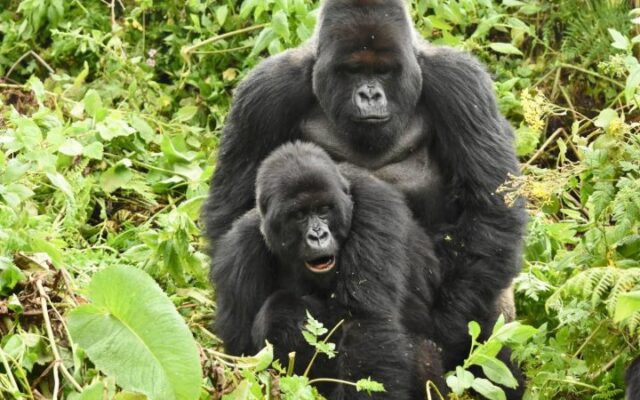
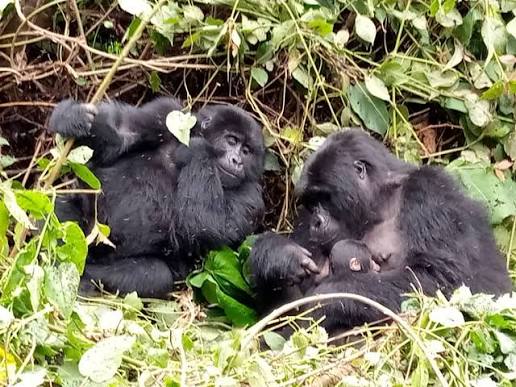
Few wildlife scenes are as moving as watching a mountain gorilla mother with her baby in the forests of Uganda. A tiny infant may cling tightly to its mother’s chest while she feeds, moves through vegetation or rests among other members of the family. As the youngster grows, it gradually becomes more adventurous, first reaching away from its mother, then crawling nearby, climbing vegetation and eventually playing with other young gorillas.
Understanding how gorilla mothers raise babies reveals one of the most fascinating aspects of mountain gorilla society. Gorilla infants develop slowly compared with many other mammals. They require years of care, protection and social learning before becoming independent. During this long childhood, mothers provide food, transport, warmth, security and opportunities to learn about life within a gorilla family.
Introduction
The relationship between a mother and her infant is therefore central to the youngster’s survival and development. For visitors trekking mountain gorillas in Bwindi Impenetrable National Park or Mgahinga Gorilla National Park, seeing this relationship firsthand can become one of the most memorable moments of the entire safari.
A Gorilla Baby Starts Life Completely Dependent on Its Mother
Newborn mountain gorillas are tiny compared with the enormous adults around them. During their earliest stage of life, they depend almost entirely on their mothers. The infant remains in very close physical contact, usually clinging to the mother’s body as she moves. A newborn cannot simply follow the family through the forest independently. Its mother becomes its transportation, food source, protection and safest place.
This strong physical attachment is one reason baby gorillas can sometimes be difficult for trekkers to photograph during their earliest months. The mother may hold the infant close to her chest, partly obscuring it from view. You may first notice a tiny hand, foot or dark face appearing through her arms.
How Gorilla Mothers Carry Their Babies
During the first months of life, the infant clings primarily to the mother’s front. As it grows stronger and develops better coordination, it can increasingly ride on her back. Watching an older infant riding across its mother’s back while she moves through Bwindi is an unforgettable sight. The baby holds onto the mother’s fur as she walks through vegetation, climbs slopes or changes feeding locations. To a human observer, the journey can look surprisingly rough. The mother may move across uneven ground, push through thick vegetation or climb. The infant, however, develops the strength and coordination needed to remain attached.
Gorilla Mothers Nurse Their Infants
Milk provides the infant’s primary nutrition early in life. The baby nurses regularly while remaining close to its mother. As the youngster grows, it gradually begins experimenting with solid foods. It may watch its mother feeding and eventually begin tasting leaves, stems and other vegetation. This transition is gradual rather than immediate. Nursing can continue even after the infant has begun consuming plant foods. The mother’s role therefore changes slowly as the youngster develops rather than ending at a single moment.
Learning What to Eat
A mountain gorilla grows up surrounded by food, but recognizing useful food still requires experience. Young gorillas observe adults constantly. A baby sees its mother select certain leaves, stems, shoots and other vegetation. Over time, the youngster begins manipulating similar foods. It learns how to handle plants and which parts are worth eating. This is one of countless examples of how growing up within a social group provides information that would be difficult for a young animal to acquire alone.
Protection Is One of the Mother’s Most Important Roles
A gorilla mother is extremely attentive to her infant. During the baby’s earliest months, she maintains almost continuous proximity. If something unusual happens, she can quickly gather the infant close. Other adult members of the family, particularly the dominant silverback, also contribute indirectly to the security of the group. However, the mother is the infant’s immediate source of protection. Her presence is especially important because young gorillas are physically vulnerable.
Gorilla Mothers and Silverbacks
The relationship between mothers, infants and the family’s leading silverback can be fascinating. An enormous silverback may sit only a short distance from a tiny infant. Despite the dramatic difference in size, interactions can be remarkably calm. The silverback’s role in protecting and maintaining the family creates a safer social environment in which youngsters develop.
Older infants and juveniles may eventually interact directly with the silverback, sometimes playing near him or approaching him with surprising confidence. Visitors often find these scenes particularly memorable because they reveal a completely different side of an animal famous for its strength.
Do Silverbacks Help Raise Babies?
The mother provides the most direct infant care, but the wider family matters enormously. Silverbacks can play important protective and social roles. They do not generally provide the same nursing and constant carrying care performed by mothers, but youngsters may build social relationships with them. A silverback can tolerate infants climbing around him, rest near youngsters or interact with them. In some situations, the male can also become an important source of security for young gorillas. Gorilla parenting is therefore centered on the mother but embedded within a wider social family.
The First Steps Toward Independence
As an infant becomes stronger, its world gradually expands. Instead of remaining attached continuously, it begins exploring very close to its mother. Perhaps it reaches toward a branch. Then it moves a short distance. Eventually it crawls or climbs independently.
The mother remains nearby. These early explorations allow the youngster to develop coordination and confidence while still having immediate access to safety. The process resembles a widening circle around the mother. At first, the infant’s world is essentially her body. Later, it includes the ground beside her.
Eventually, it extends to playmates and increasingly distant parts of the feeding area.
Play Becomes Extremely Important
Young gorillas are famously playful. As infants develop into juveniles, play occupies a significant place in their lives. They chase each other. They wrestle. They climb. They roll across vegetation. They may perform miniature versions of adult displays. Play is entertaining to watch, but it has serious developmental value. Through play, young gorillas improve strength, coordination and social skills. They learn how other individuals react. They discover when play becomes too rough. They practice movements and behaviors that will later become part of adult life.
Mothers Allow Increasing Independence
A good way to understand how gorilla mothers raise babies is to think about gradual independence. The mother does not suddenly stop caring for her youngster. Instead, the infant becomes progressively capable. It spends more time away from her. It eats more solid food. It travels short distances independently. It plays with other youngsters. Eventually, it no longer needs to ride on its mother. The relationship continues, but the youngster’s dependence changes.
Young Gorillas Learn Social Rules
Living in a gorilla family requires more than knowing what to eat. A young gorilla must learn how to behave around: Every interaction provides information. A youngster learns who tolerates play. It learns when an adult wants to be left alone. It becomes familiar with vocalizations, gestures and body language. This social education cannot be separated from growing up.
What Happens When a Baby Wanders Too Far?
As youngsters become adventurous, they sometimes move farther from their mothers. Mothers remain aware of their infants and may retrieve, approach or otherwise respond when necessary. The exact response depends on the age of the infant and circumstances. Older juveniles naturally receive far more freedom than tiny babies. Watching this changing relationship is one of the joys of repeated gorilla observation. A youngster that once remained permanently attached to its mother may later become one of the most energetic members of the family.
Gorilla Mothers Have Individual Personalities
Not every mother behaves identically. Long-term observers recognize differences between individuals. Some mothers may appear particularly tolerant. Others may be more protective. Their previous parenting experience can influence behavior. The infant also has its own personality. One youngster may be cautious. Another may constantly explore. These individual differences make each gorilla family unique.
Experienced Mothers Versus First-Time Mothers
Like humans and many other social mammals, experience can influence maternal behavior. A female raising an infant for the first time faces a different situation from an older female that has successfully raised several youngsters. Long-term monitoring allows researchers to observe these differences across generations. It also provides valuable information about reproductive success and infant survival.
Gorilla Childhood Is Long
One reason maternal care is so important is that gorillas develop relatively slowly. They do not reach independence within weeks or a few months. Childhood extends across years. This prolonged development gives young gorillas time to learn complex social behaviors and environmental knowledge. The mother’s role gradually changes throughout this period. She moves from providing nearly everything to becoming an important relationship within an increasingly independent youngster’s social world.
What Happens When Another Baby Is Born?
The arrival of a younger sibling can alter family dynamics. An older youngster that previously received substantial maternal attention may need to become more independent when the mother has a newborn. This can produce interesting interactions. Older offspring may remain near their mother while learning that the new infant now requires intensive care. The family continues adjusting as each generation develops.
Gorilla Mothers and Loss
Wildlife lives are not always easy. Infants sometimes die from illness, accidents or other natural causes. For a socially complex animal such as a gorilla, these losses can influence maternal behavior and family interactions. Researchers have observed behaviors associated with death and loss that remind us of the depth of great ape social relationships. Responsible gorilla tourism should never treat these events as spectacles. They are part of the natural lives of the animals being observed.
Why Human Disease Is Dangerous to Gorilla Babies
Young gorillas can be particularly vulnerable. Mountain gorillas are genetically close enough to humans that disease transmission is a serious conservation concern. This is one reason gorilla trekking has strict health and distance regulations. If visitors are ill, they should be honest with guides and wildlife authorities. Protecting infants and other family members is far more important than completing one tourist’s planned trek.
Health guidelines are therefore a crucial part of responsible gorilla tourism.
Why Visitors Must Keep Their Distance
Seeing a baby gorilla can make visitors want to move closer. That is precisely what you should not do. Distance rules help reduce disturbance and disease risk. If a gorilla moves closer independently, follow your ranger’s instructions. Never approach an infant. Never attempt to touch one. And never position yourself between a mother and her baby. The goal is to observe natural family behavior without becoming part of it.
Why Gorilla Mothers Are Fascinating to Photograph
A mother-and-infant photograph can capture remarkable tenderness. You may see the infant looking over its mother’s shoulder. Another might be nursing. An older baby could be riding on her back. Sometimes a mother sits peacefully while the youngster explores nearby. However, avoid becoming so focused on photography that you stop observing. Some of the most meaningful interactions happen quickly and may not produce the perfect photograph.
What Trekkers Can Learn From Watching Mothers
Watching gorilla mothers gives visitors insight into the social complexity of the entire family. You see patience. Protection. Learning. Independence. Play. Communication. You begin understanding gorillas as individuals with relationships rather than simply members of a wildlife species. For many trekkers, this emotional realization becomes more important than the initial excitement of seeing a silverback.
Where Can You See Gorilla Mothers and Babies in Uganda?
Mountain gorillas can be trekked in Uganda’s: Bwindi Impenetrable National Park and Mgahinga Gorilla National Park. Whether a particular family has a very young infant depends on births within habituated groups at the time of your visit. No responsible safari operator should guarantee that you will see a newborn. Gorilla families are dynamic and continuously changing.
Every Baby Matters to Conservation
Mountain gorillas reproduce slowly. A female invests substantial time in each infant, and the interval between births is measured in years rather than months. This means every successful birth contributes meaningfully to the population. Conservationists monitor births closely because they help reveal the health and development of known gorilla groups. For visitors, seeing a thriving infant is therefore more than simply a cute safari moment. It represents another young member of an important wild population.
Final Thoughts
Understanding how gorilla mothers raise babies makes a mountain gorilla encounter even more meaningful. A mother carries her newborn almost constantly during the earliest stage of life. She nurses, protects and transports the infant while it gradually begins exploring its surroundings. As the youngster grows, it learns by watching. It begins eating vegetation.
It plays. It interacts with siblings, juveniles, females and silverbacks. Its mother gradually allows more independence while remaining an essential social relationship. The process takes years. And if you are fortunate enough to see a tiny infant peering through its mother’s arms in Bwindi, remember that you are witnessing the beginning of that remarkable journey.
The little gorilla before you will spend years learning how to feed, communicate, travel and live within its family. One day, that tiny male might even become a huge silverback. But first, he needs his mother.
 Read