

For many travelers planning an African adventure, one question comes up repeatedly: is gorilla trekking worth it? The cost of a gorilla permit, the journey to the mountainous forests, and the physical effort required to reach a gorilla family can make travelers wonder whether the experience justifies the investment. For most people who actually make the journey into Uganda’s gorilla forests, the answer is a resounding yes.
Gorilla trekking is unlike a conventional wildlife safari. You are not watching animals from a vehicle or viewing them from a distant observation point. You walk through a living tropical forest with experienced trackers, following signs left by a family of wild mountain gorillas. Eventually, the vegetation opens and you find yourself standing only a short distance from one of the world’s most remarkable primates.
Introduction
That combination of adventure, anticipation, conservation and an extraordinarily intimate wildlife encounter is what makes gorilla trekking one of Africa’s most memorable experiences.
Why Gorilla Trekking Feels Different From a Normal Safari
A traditional African safari usually involves traveling through open landscapes in a 4×4 vehicle while searching for lions, elephants, giraffes, buffaloes and other wildlife. Gorilla trekking is completely different. The experience begins on foot. In Uganda, most gorilla treks take place in Bwindi Impenetrable National Park and Mgahinga Gorilla National Park. These landscapes are mountainous, green and densely forested.
Rather than simply driving toward an animal sighting, trekkers become part of the search. Your guides and trackers look for signs such as broken vegetation, feeding remains, footprints and nesting areas. Because gorillas move through the forest every day, their location cannot simply be predicted like an attraction with a fixed viewing point. This uncertainty creates anticipation. Every bend in the trail could bring you closer.
The Morning of Your Gorilla Trek
A typical gorilla trekking day begins early. After breakfast at your lodge, you travel to the relevant park headquarters or trekking sector for registration and briefing. Uganda Wildlife Authority rangers explain important trekking rules and give visitors information about the gorilla families. You are then allocated to a trekking group and introduced to the ranger guides who will accompany you. Depending on where the gorillas spent the previous night, your trek may begin directly from the briefing area or involve a short transfer to a trailhead. From there, the adventure begins.
The Trek Through the Forest
There is no standard duration for a gorilla trek. Some groups may locate their gorilla family relatively quickly. Others may walk for several hours. That unpredictability is part of the experience. The terrain can include forest paths, hillsides, streams, tangled vegetation and occasionally muddy sections. Bwindi’s name is often translated in reference to its seemingly impenetrable vegetation, and once you enter the forest, the description begins to make sense. But the walk itself should not be regarded merely as an obstacle between you and the gorillas. It is part of the adventure. You are exploring one of Africa’s extraordinary tropical forests. Along the way, your guides may point out birds, butterflies, plants, monkeys and signs of other wildlife. The forest gradually becomes part of the story.
The Moment You First See a Mountain Gorilla
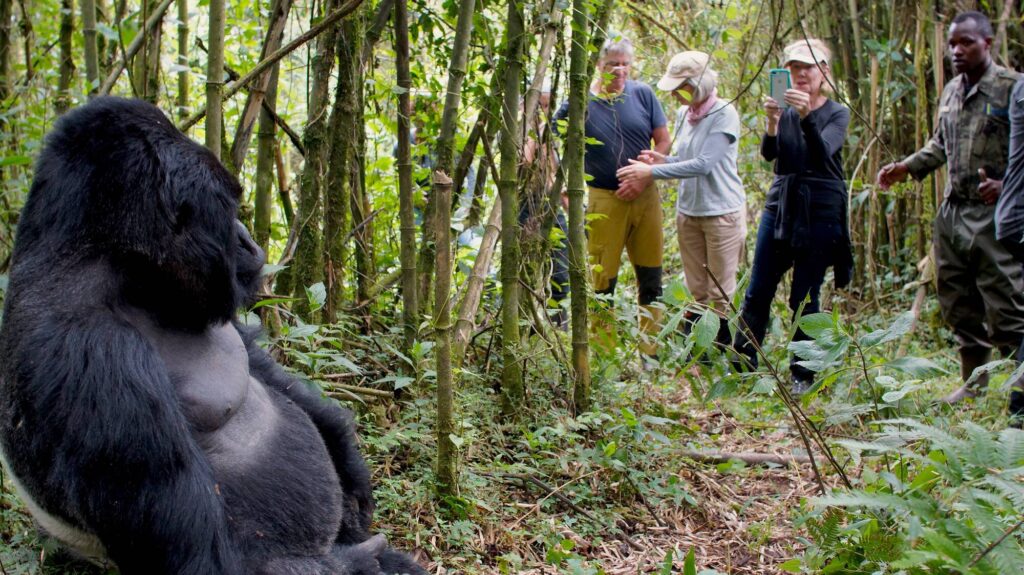
Eventually, your ranger may ask everyone to stop. The trackers have found the gorillas. Walking sticks and unnecessary equipment may be left with the porters while you prepare your camera. Voices become quieter. You move forward slowly. Then, through the vegetation, you see your first mountain gorilla. It might be a female feeding quietly. It could be a juvenile climbing through branches. Or perhaps the first gorilla you notice is the enormous silverback sitting among the vegetation. For many travelers, this is the moment when the question “is gorilla trekking worth it?” disappears completely. Photographs rarely prepare you for the physical presence of a mountain gorilla. Their size, expressions, hands, eyes and movements can feel remarkably familiar while remaining unmistakably wild.
One Hour With a Gorilla Family
Standard gorilla trekking permits generally allow visitors to spend up to one hour with the gorillas once the family has been located. That hour can pass surprisingly quickly. The gorillas may continue feeding as though you are hardly there. A mother might carry an infant. Young gorillas may wrestle or climb. A silverback may sit quietly watching his family. Sometimes individuals move through the vegetation and pass closer than expected. Visitors must follow the instructions of the ranger guides and maintain the required distance whenever possible. However, gorillas do not understand human measuring rules. Occasionally one may walk closer on its own. When this happens, guides tell visitors exactly how to respond. The important thing is to remain calm and allow the ranger to control the situation.
Why the Experience Can Feel So Emotional
Mountain gorillas are among our closest living relatives. Their expressions and social interactions can therefore appear surprisingly recognizable. Watching a mother hold an infant, seeing juveniles play or observing a silverback watching over his family can create an emotional connection that is difficult to experience with many other wild animals. The encounter also carries a sense of privilege. Mountain gorillas survive naturally in a very limited region of Africa. Seeing them in their forest habitat is therefore not simply another wildlife sighting. You are entering their world.
Is Gorilla Trekking Too Expensive?
Cost is one of the main reasons travelers question whether gorilla trekking is worth doing. A Uganda gorilla trekking safari includes more than the permit itself. Travelers must normally consider:
For travelers visiting Uganda primarily for a conventional safari, adding gorilla trekking can significantly increase the total holiday budget. However, the experience is also fundamentally different from an ordinary game drive. Gorilla permits contribute to the controlled tourism system that makes it possible to manage visitor numbers and support conservation.
Rather than evaluating the experience only by the number of hours spent with gorillas, it is useful to consider the entire experience: the journey into southwestern Uganda, the forest trek, professional tracking operation and rare wildlife encounter.
Is Gorilla Trekking Physically Difficult?
It can be. But difficulty varies enormously. One traveler may trek for less than two hours before reaching the gorillas. Another group may spend several hours navigating steeper terrain. Weather also changes the experience. Rain can make forest trails muddy and slippery. Visitors should therefore arrive prepared with proper hiking shoes, long trousers, suitable clothing and rain protection. Hiring a porter is highly recommended. Porters can carry backpacks, cameras and drinking water and may provide assistance on difficult sections of the trail. Using a porter also directly supports members of communities surrounding the gorilla parks.
Do You Need to Be Extremely Fit?
No. You do not need to be an athlete to enjoy gorilla trekking. However, a reasonable level of walking fitness makes the experience more comfortable. If you have concerns about mobility or trekking difficulty, tell your safari operator in advance. Depending on permit availability and park arrangements, it may sometimes be possible to request consideration for a gorilla family whose usual range may offer a more manageable trek. Nothing can be guaranteed because gorillas are wild and move freely.
Is Uganda a Good Place for Gorilla Trekking?
Uganda is one of the world’s principal destinations for seeing mountain gorillas. Most trekking takes place in Bwindi Impenetrable National Park, a UNESCO World Heritage Site in southwestern Uganda. Bwindi contains several trekking sectors, including Buhoma, Ruhija, Rushaga and Nkuringo. Uganda also offers gorilla trekking in Mgahinga Gorilla National Park, part of the wider Virunga landscape. One major advantage of choosing Uganda is the opportunity to combine gorilla trekking with a broader safari. A trip can include: This makes Uganda particularly attractive for travelers wanting primates and classic African wildlife within one itinerary.
What Makes Gorilla Trekking Worth the Journey?
The most powerful part of gorilla trekking is difficult to capture in photographs. It is the combination of anticipation and proximity. You have spent hours traveling toward the forest. You wake before sunrise. You meet your ranger. You walk into the mountains. You follow tracks through vegetation. Then suddenly the animal you have traveled across the world to see is sitting only meters away. There is no glass barrier. No cage. No artificial enclosure. You are standing in a wild African forest while a mountain gorilla continues its daily life nearby. That is what makes the experience extraordinary.
Who Might Not Enjoy Gorilla Trekking?
Gorilla trekking is not necessarily the right activity for every traveler. Someone expecting guaranteed easy walking, unlimited photography time or a completely predictable schedule may find the experience challenging. It is also important to understand that wildlife behavior cannot be staged. The gorillas may be sleeping. They may be feeding behind vegetation. The silverback may spend much of your visit resting. That is precisely what makes the experience authentic. You are observing wild animals rather than watching a performance.
How to Make Gorilla Trekking More Worthwhile
Preparation makes an enormous difference. Choose comfortable hiking footwear. Carry rain protection. Wear long trousers and long sleeves. Take sufficient drinking water. Use a porter. Protect your camera equipment from moisture. Most importantly, do not spend the entire encounter looking through your camera. Take photographs, but also put the camera down occasionally. Watch. Listen. Notice how the gorillas communicate. Observe how the silverback positions himself. Watch juveniles interact. Those moments often become more memorable than the photographs.
Combining Gorilla Trekking With a Uganda Safari
For many visitors, the best way to maximize the value of a gorilla permit is to incorporate trekking into a longer Uganda safari. A short itinerary may combine Queen Elizabeth National Park and Bwindi, allowing travelers to experience lions, elephants, buffaloes and hippos before entering the gorilla forest. Longer itineraries can add Kibale Forest for chimpanzees and Murchison Falls for traditional big-game viewing. This creates one of Africa’s most varied wildlife journeys. Instead of flying internationally for a single activity, you experience several distinct ecosystems and wildlife encounters.
Is Gorilla Trekking Worth It for Photographers?
Absolutely, although conditions can be challenging. The forest is often dark. Vegetation can obstruct clear views. Gorillas move unpredictably. Flash photography is prohibited. Yet these challenges can produce extraordinary photographs. Soft forest light, expressive gorilla faces and the green surroundings of Bwindi create images that are completely different from photographs taken on open savannahs. Photographers should prioritize suitable lenses, high ISO capability and protection against moisture.
Is Gorilla Trekking Worth It for a Once-in-a-Lifetime Trip?
This is where gorilla trekking becomes particularly compelling. There are many places where travelers can see elephants, lions or giraffes. Mountain gorillas exist naturally in only a very small part of the world. The opportunity to walk into their habitat and observe a habituated family at close range is therefore genuinely unusual. For travelers building a once-in-a-lifetime African itinerary, gorilla trekking deserves serious consideration.
Final Verdict: Is Gorilla Trekking Worth It?
Yes—for travelers who value wildlife, conservation, adventure and unusual experiences, gorilla trekking in Uganda is absolutely worth it. It requires planning. It requires a significant budget. The forest walk may be physically demanding. The weather may be unpredictable.
But these factors are also part of what makes the encounter meaningful. You have not simply arrived at an observation platform. You have followed mountain gorillas into one of Africa’s great forests. And when you finally sit quietly among the vegetation watching a silverback, mother or playful juvenile only a short distance away, the journey suddenly makes sense.
For many visitors to Uganda, that hour becomes not only the highlight of their safari but one of the most memorable wildlife experiences of their lives.

 Read
