

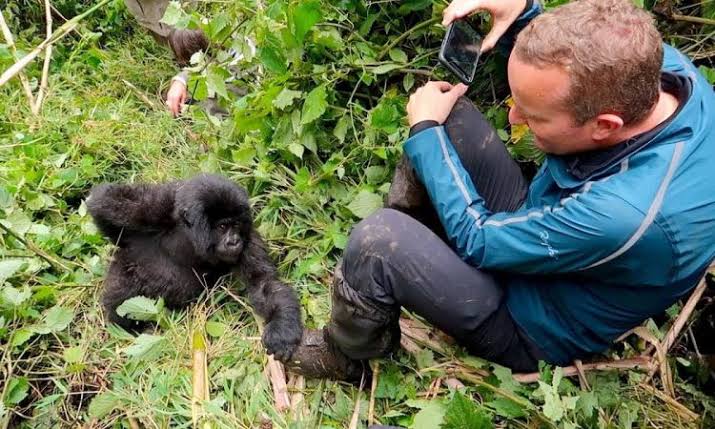
One of the most exciting—and sometimes intimidating—possibilities during a gorilla trek is having a mountain gorilla move closer than expected. Travelers often ask, what happens if a gorilla approaches you while trekking in Uganda?
The first thing to understand is that visitors are not supposed to deliberately approach mountain gorillas. Gorilla trekking is a carefully controlled wildlife experience, and travelers are expected to maintain the viewing distance specified by Uganda Wildlife Authority rangers. Current UWA rules require visitors to maintain a distance of approximately 10 meters from gorillas whenever conditions allow.
Introduction
Mountain gorillas, however, do not understand tourism regulations. A gorilla may decide to walk along the same path where visitors are standing. A juvenile may become curious. A female carrying an infant may move between feeding areas. Occasionally, even a large silverback may walk surprisingly close to a trekking group.
When that happens, the most important rule is simple: Stay calm and follow your ranger’s instructions. You should never reach toward the gorilla, attempt to touch it, run away or deliberately move closer for a photograph.
Why Would a Mountain Gorilla Approach a Human?
Mountain gorillas encountered by tourists belong to habituated families. Habituation is a gradual process through which wild gorillas become accustomed to the predictable presence of researchers, trackers and carefully managed visitor groups. They remain completely wild. Habituation simply means they have learned that properly behaving humans accompanied by familiar trackers and rangers do not normally represent a threat.
This is why a gorilla may sometimes continue feeding, resting or walking while tourists are nearby. If a gorilla approaches you, it does not necessarily mean it wants to interact with you. It may simply be moving to another part of the forest. You could be standing near vegetation it wants to eat. A juvenile might be exploring its surroundings.
The gorilla may even be following another family member. Rather than trying to interpret the animal yourself, allow your ranger to assess its behavior.
What Should You Do When a Gorilla Starts Walking Toward You?
Your ranger will normally notice the gorilla’s movement before you need to react. Listen immediately to whatever instructions are given. You may be asked to remain still, lower your posture, move slowly to one side or simply allow the gorilla to pass. Avoid sudden movements. Do not jump backward.
Do not shout. Most importantly, do not run. Mountain gorilla encounters are supervised by people who work around these animals regularly and understand their behavior far better than an occasional visitor. The safest response is therefore not to improvise. Follow the ranger.
What Does It Feel Like When a Gorilla Approaches?
Even travelers who understand the rules intellectually can experience a rush of adrenaline when a gorilla begins moving toward them. Imagine sitting quietly in a dense section of Bwindi Impenetrable Forest. Several meters ahead, a gorilla is pulling leaves from a plant. Then it stands. It begins walking. Instead of moving away, it comes toward your group. Suddenly those several meters disappear. When an adult gorilla is nearby, you become very aware of its physical presence. You can hear vegetation breaking. You may hear its breathing. You notice the size of its hands, shoulders and head. A silverback can appear especially enormous when viewed without a vehicle, fence or viewing platform between you. Yet the correct response remains calmness.
What If the Gorilla Walks Directly Past You?
This can happen. A gorilla may simply need to get from one location to another, and visitors may happen to be near its preferred route. If that occurs, the ranger will manage the situation. Visitors should normally remain quiet and avoid sudden movements. Do not turn the moment into an opportunity to move toward the gorilla. Do not extend your arm. Do not attempt to take a selfie with the animal. Allow it to pass. Some of the most extraordinary gorilla trekking memories come from these unscripted moments precisely because visitors did nothing to create them. The gorilla made the decision. You simply happened to witness it.
What Happens If a Gorilla Touches You?
Very close encounters are possible, particularly when curious younger gorillas move around a family. If a gorilla unexpectedly makes contact, you should not attempt to touch it back. Remain calm. Avoid sudden movement and follow the ranger’s directions. There is an important distinction between a gorilla accidentally or deliberately closing the distance and a tourist attempting physical interaction. Visitors must never initiate contact. Gorillas are not domesticated animals. They are wild primates living inside protected natural habitats. Even when a juvenile appears playful or curious, touching it would be inappropriate and could create both conservation and safety problems.
Why You Should Never Reach Out to a Gorilla
Seeing a gorilla within touching distance can produce an almost instinctive desire to reach toward it. Resist that temptation. Physical contact can increase the risk of disease transmission. Mountain gorillas share biological similarities with humans and can be susceptible to diseases carried by people. That is one reason health and distance regulations are taken seriously during gorilla trekking. Responsible tourism means protecting the animals even when an extraordinary photographic or physical opportunity presents itself. Your memory of a gorilla passing close to you will be remarkable without touching it.
Are Mountain Gorillas Aggressive Toward Tourists?
Mountain gorillas are extremely powerful animals, but habituated families encountered during controlled tourism are generally tolerant of properly managed visitor groups. The International Gorilla Conservation Programme notes that mountain gorillas are generally not aggressive toward tourists and that threatening behavior toward visitors is uncommon when trekking rules are respected. That does not mean they should be treated casually.
A gorilla’s calm behavior should never be mistaken for domestication. You are still standing near a wild animal capable of enormous physical strength. That is why ranger instructions always take priority over a visitor’s desire for photographs or a closer look.
What If a Juvenile Gorilla Approaches?
Young gorillas are often among the most entertaining members of a family. They climb. They wrestle. They chase one another. They sometimes tumble through vegetation with seemingly endless energy. Their curiosity can occasionally bring them close to visitors. A juvenile might walk toward the group or move past while playing. Do not encourage it. Never hold out your hand, backpack, camera or another object. Do not make noises in an attempt to attract the youngster. Allow it to behave naturally. Remember that adult family members—particularly the silverback—remain responsible for the young gorillas. Your behavior should communicate that you are peaceful, predictable and uninterested in interfering.
What If a Silverback Approaches?
This is usually the encounter visitors remember most vividly. A mature silverback is an enormous animal. When one begins walking in your direction, the natural human reaction may be fear. But a silverback walking toward you does not automatically mean aggression. He may simply be changing position. He could be following family members. He might be moving to another feeding location. Remain where instructed and allow your ranger to interpret what is happening. Do not attempt to challenge the animal by behaving dramatically. Do not run. Do not suddenly raise your arms. Do not shout. Remain calm and give the silverback the space and respect he deserves.
Should You Make Eye Contact?
Visitors naturally look at the gorillas. You are there to observe them. However, prolonged direct staring can be interpreted differently in primate communication than ordinary human eye contact. If a gorilla is extremely close or displaying, avoid deliberately staring it down. Follow your ranger’s instructions about posture and behavior. The objective is never to demonstrate bravery. It is to remain non-threatening.
Why Rangers Are So Important During Close Encounters
Professional ranger guides are one of the most important elements of gorilla tourism. They understand the individual gorilla families. They recognize behaviors and vocalizations. They communicate with trackers. They know when a gorilla is relaxed, moving normally or becoming uncomfortable.
Visitors should therefore avoid making independent decisions during an unexpected close encounter. If the ranger says stay still, stay still. If the ranger asks you to lower yourself, do so. If you are told to move slowly, move slowly. These instructions are based on experience rather than guesswork.
Do Gorilla Encounters Ever Become Frightening?
They can certainly feel intense. Hearing a large silverback vocalize nearby can make your heart race. Watching vegetation shake as a gorilla moves toward you can create uncertainty. A dominance display can appear dramatic to someone seeing one for the first time. The important distinction is between something feeling frightening and actually being an attack. Wild animals communicate in ways visitors may not understand. A ranger can interpret those signals and tell the group how to react.
Can You Take Photos When a Gorilla Is Very Close?
Photography is normally part of the trekking experience, but protecting the animals comes first. UWA rules prohibit flash photography while visitors are with gorillas. If an animal suddenly approaches, your first thought should not be about getting the perfect photograph. Listen to the ranger. Once the situation is calm, you may continue photographing if appropriate. Sometimes the best photographs happen naturally without visitors constantly repositioning themselves.
Why Keeping Your Distance Protects Gorillas
Distance rules are particularly important because humans can transmit respiratory illnesses and other infections to great apes. This changes the way responsible travelers should think about proximity. Getting unusually close is not something tourists should deliberately pursue. The goal is to observe natural gorilla behavior while minimizing human impact.
If a gorilla independently comes closer, that is a different situation, but visitors still need to behave responsibly.
What If You Are Nervous About Close Gorilla Encounters?
Feeling nervous is completely normal. Most people have never stood near an animal as physically powerful as a silverback. Before entering the forest, listen carefully during your briefing. Ask the ranger practical questions if you are uncertain about expected behavior. Once the trek begins, stay near your guide. Knowing that experienced professionals are managing the encounter makes it much easier to relax. Most visitors discover that their nervousness disappears once they have spent several minutes quietly observing the family.
How Long Are You With the Gorillas?
Standard gorilla trekking visits in Uganda are generally limited to one hour once the allocated habituated family has been located. UWA also notes that the overall trek can take several hours depending on the location of the gorillas and forest conditions. During that hour, your position may change as the gorillas move. Sometimes the family remains in one feeding area. At other times, visitors carefully follow under ranger supervision. That movement is why unexpected close encounters occasionally occur.
The Right Way to Think About a Close Encounter
Do not begin a gorilla trek hoping to touch a gorilla. Do not consider the trek unsuccessful if one never approaches you. A responsible gorilla encounter does not need physical contact. Seeing a wild mountain gorilla in its natural habitat from the recommended distance is already an extraordinary privilege. If one happens to walk closer, treat the moment with respect.
Remain still. Listen to your guide. Observe. Let the gorilla make its own decisions.
Final Answer: What Happens If a Gorilla Approaches You?
So, what happens if a gorilla approaches you while trekking? You stay calm, avoid sudden movements and immediately follow the instructions of your ranger guide. You do not reach for the gorilla. You do not touch it. You do not run.
You do not move closer for a photograph. If the gorilla decides to pass very close or even makes accidental contact, allow the ranger to manage the encounter and let the animal continue on its way. These spontaneous moments can become some of the most memorable experiences of a Uganda gorilla safari. The magic comes from realizing that you are not controlling the encounter.
You are a temporary visitor inside the gorilla’s world—and for a few extraordinary seconds, one of those wild mountain gorillas may choose to walk right past you.

 Read

