Chimpanzee: Uganda and Rwanda Wildlife Guide
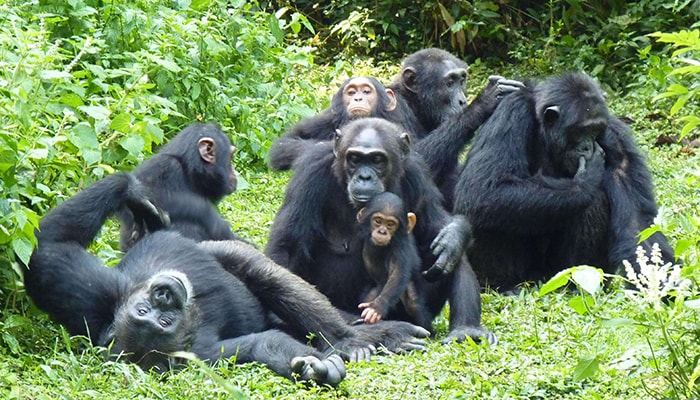
The chimpanzee is one of Africa’s most intelligent and fascinating primates and one of the major wildlife highlights of safaris in Uganda and Rwanda. Closely related to humans, chimpanzees display complex social relationships, use tools, communicate through a wide range of vocalizations and gestures, and live in dynamic communities that can contain dozens of individuals.
Uganda is one of the best destinations in Africa for seeing wild chimpanzees, particularly in Kibale National Park, where guided chimpanzee trekking is one of the country’s signature primate experiences. Other Ugandan forests also support chimpanzee populations. Rwanda offers chimpanzee tracking primarily in Nyungwe National Park, where visitors can combine primate encounters with hiking, birding and rainforest exploration.
For travelers already planning mountain gorilla trekking, adding chimpanzee tracking provides an excellent opportunity to compare the behavior of two of Africa’s great apes.
What Is a Chimpanzee?
The chimpanzee is a great ape belonging to the genus Pan. It is one of the closest living relatives of humans. Chimpanzees have long arms, powerful upper bodies and highly expressive faces. Unlike monkeys, they do not have tails.
Adults vary greatly in size, and males are generally larger and more muscular than females. Their dark hair covers much of the body, while the face, ears, palms and soles are relatively hairless.
Chimpanzees are adapted to both climbing and ground travel. They can move through trees with impressive agility but also spend considerable time walking on the forest floor. Their combination of physical ability, intelligence and flexible behavior allows them to occupy several different forest environments.
Where Do Chimpanzees Live?
Wild chimpanzees are found across parts of equatorial Africa. Their habitats include tropical rainforest, woodland and forest-savannah mosaics. In Uganda, important chimpanzee habitats include Kibale National Park, Budongo Forest, Kyambura Gorge and other protected forest areas.
Kibale is particularly famous because it combines a substantial chimpanzee population with long-established tourism and research programs. In Rwanda, the main destination for travelers hoping to see chimpanzees is Nyungwe National Park in the southwest.
Nyungwe protects a vast area of montane rainforest and is home to numerous primate species in addition to chimpanzees.
Chimpanzee Habitat
Chimpanzees are highly adaptable compared with some other great apes. They can live in dense tropical forests, secondary woodland and areas containing a mixture of forest and grassland. Food availability is a major influence on how chimpanzees move through their habitat.
Fruit-producing trees are especially important because fruit forms a significant portion of their diet. Chimpanzees may travel considerable distances during the day to locate feeding areas. Their ability to move both on the ground and through trees helps them exploit different food sources.
For visitors, this means chimpanzee tracking can be an active experience because the animals may continue moving while being observed.
What Do Chimpanzees Eat?
Chimpanzees are omnivorous. Fruit is a major component of their diet, but they also eat leaves, seeds, flowers, bark and other plant material. They may consume insects such as termites and ants.
Chimpanzees are also known to hunt smaller animals in certain populations. Their feeding behavior is one of the strongest examples of chimpanzee intelligence. In some areas, chimpanzees use sticks to extract insects, stones to crack hard foods or leaves as improvised tools.
Different communities may develop different techniques, illustrating a form of learned behavior passed between individuals.
Chimpanzee Social Structure
Chimpanzees live in large communities with what scientists describe as a fission-fusion social system. This means that the entire community does not remain together all day. Instead, smaller parties form and separate depending on food availability, social relationships and individual activities.
Adult males often maintain strong alliances and compete for status. Females may spend more time with their offspring or in smaller parties. These constantly changing social groups make chimpanzee societies remarkably complex.
Visitors may encounter only a portion of the community during a trek, while other members remain elsewhere in the forest.
Dominance and Male Relationships
Adult male chimpanzees usually participate in a social hierarchy. Dominance is not determined only by physical strength. Relationships, alliances and social intelligence can play major roles.
A male may gain support from others through grooming and coalition-building. Changes in leadership can involve displays, competition and shifting alliances. This political dimension of chimpanzee society has fascinated researchers for decades.
Watching even a short interaction between males can provide clues about their relationships within the wider community.
Female Chimpanzees and Infants
Female chimpanzees invest heavily in raising their young. A newborn infant remains closely dependent on its mother and is carried during movement through the forest. Young chimpanzees gradually become more independent but continue learning from their mothers for several years.
This long period of development allows juveniles to acquire feeding techniques, social knowledge and survival skills. Visitors may see infants clinging beneath their mothers or riding on their backs. Older youngsters often play with one another, climb branches and imitate adults.
Chimpanzee Communication
Chimpanzees use an extensive range of sounds, facial expressions and gestures. One of the most famous vocalizations is the pant-hoot, a loud call that can travel through the forest. Groups may also scream, grunt, bark or make softer contact calls.
Researchers can sometimes identify individuals from their distinctive calls. Body language is equally important. A chimpanzee may use gestures to request grooming, initiate play or communicate social intentions. Their expressive faces can also reveal excitement, tension or relaxation.
Chimpanzee Intelligence
Chimpanzees are renowned for their intelligence. Wild chimpanzees can use tools, solve problems, remember the location of food resources and learn from other community members. They also demonstrate complex emotional and social behavior.
Individuals form friendships, reconcile after conflicts and cooperate during certain activities. Different chimpanzee communities may develop unique traditions. This variation is sometimes described as chimpanzee culture because particular behaviors are learned socially rather than being purely instinctive.
Chimpanzee Trekking in Uganda
Uganda is one of Africa’s premier destinations for chimpanzee trekking. The most famous location is Kibale National Park. Visitors begin with a briefing before entering the forest with trained guides and trackers.
Chimpanzees can move rapidly, so trekking may involve walking through forest trails and occasionally following the animals as they travel. The experience is often energetic and unpredictable. Visitors may hear chimpanzees before seeing them, especially when pant-hoots and calls echo through the forest.
Once a habituated group is located, guests observe the animals according to park regulations.
Chimpanzee Habituation Experience
Some travelers may choose a chimpanzee habituation experience where available. Habituation is the gradual process through which wild chimpanzees become accustomed to the controlled presence of researchers and visitors.
A habituation experience generally involves spending more time following the animals than during standard tracking. This can provide deeper insight into feeding, movement and social interactions.
The experience may require a longer day in the forest, so travelers should be physically prepared and carry suitable footwear, rain protection, food and water.
Chimpanzees in Nyungwe National Park
Rwanda’s main chimpanzee destination is Nyungwe National Park. Nyungwe is a mountainous rainforest with steep slopes, deep valleys and exceptional biodiversity. Chimpanzee tracking here can be physically demanding because the terrain may be steep and the animals can move quickly.
The wider destination also offers canopy walks, hiking and birdwatching. This makes Nyungwe particularly attractive to travelers who want a broader rainforest experience rather than only a single primate encounter.
Chimpanzees and Gorillas Compared
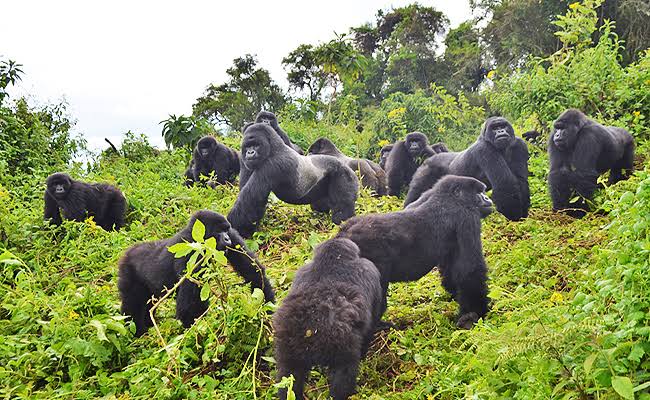
Travelers frequently combine chimpanzee tracking with mountain gorilla trekking. The two experiences are very different. Mountain gorillas often spend extended periods feeding or resting in a relatively compact area.
Chimpanzees are generally more mobile and may move rapidly through trees and along the ground. Gorilla encounters can feel calm and intimate, while chimpanzee encounters may be louder and more energetic. Experiencing both provides a fascinating comparison between two closely related great apes.
Chimpanzee Conservation
Chimpanzees face threats including habitat loss, forest fragmentation, illegal hunting and disease. Because chimpanzees reproduce slowly, population losses can take a long time to recover. Protected areas such as Kibale and Nyungwe therefore play an important role in conservation.
Tourism can contribute by generating revenue and employment linked to intact forests. Guides, trackers, lodge workers and local community tourism enterprises all benefit when forests remain valuable for wildlife tourism. Responsible tourism must nevertheless keep visitor numbers and behavior carefully controlled.
What to Wear for Chimpanzee Trekking
Useful equipment includes:
- Strong walking or hiking shoes - Long trousers - Long-sleeved shirt - Waterproof jacket - Small daypack - Drinking water - Insect repellent - Binoculars - Camera protection
Chimpanzees may be high in the canopy, making binoculars particularly useful. Rainfall is possible throughout the year in major chimpanzee forests.
Best Time to See Chimpanzees
Chimpanzee trekking is available throughout the year in Uganda and Rwanda. Relatively drier periods may provide easier walking conditions. However, rainforest weather is unpredictable and rain can occur at any time.
Chimpanzee movements may also vary according to food availability. Travelers should therefore focus on permit availability, safari routing and their overall travel dates rather than expecting a single perfect month.
Why See Chimpanzees on Safari?
The chimpanzee offers one of Africa’s most engaging wildlife experiences. Their intelligence, vocal communication and complex social relationships make every encounter different.
A trekking experience can begin with distant calls in the forest, develop into a fast-moving search and end with visitors watching a group groom, feed and interact only a short distance away. For travelers exploring Uganda and Rwanda, chimpanzees provide the perfect complement to mountain gorillas.
Together, these great apes offer an extraordinary insight into primate behavior and make the forests of East Africa among the most rewarding wildlife destinations on the continent.