
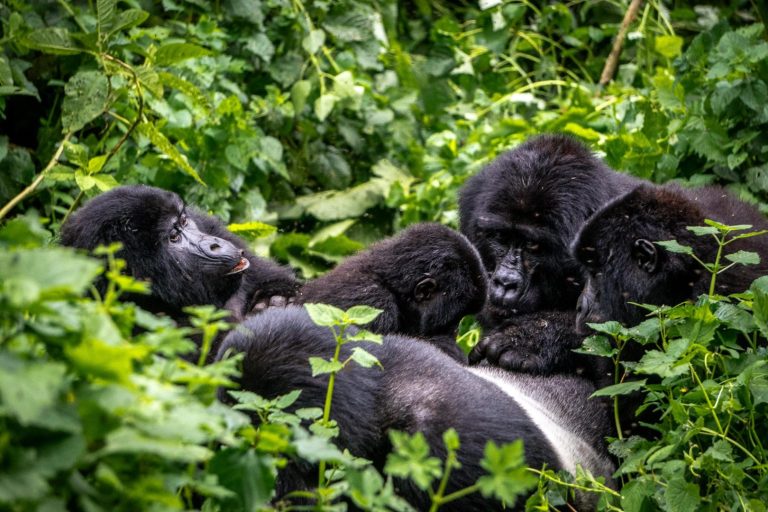
The Hirwa Gorilla Family is one of the most fascinating mountain gorilla groups associated with Rwanda's Volcanoes National Park. Its name translates roughly as lucky one or fortunate, and the group's history has included major leadership changes, rare twin births, movement through the Virunga landscape and periods of both extraordinary success and tragedy.
Hirwa was opened for tourism in 2006 and developed into a well-known family under its first dominant silverback, Munyinya. According to the International Gorilla Conservation Programme, the group later became famous for producing the second documented surviving set of mountain gorilla twins after the Susa group.
Introduction
The family's history provides an excellent introduction to the unpredictable and complex social lives of mountain gorillas.
How the Hirwa Gorilla Family Formed
Hirwa developed as a new gorilla group through the movement of individuals from other families. Its original leader, Munyinya, established himself as a dominant silverback and gradually increased the family's size.
IGCP records that he attracted or took individuals from surrounding groups including Sabyinyo, Agashya and Kwitonda. This type of social change is normal among mountain gorillas. Adult females may transfer between groups.
Silverbacks sometimes challenge other males or establish new families. As a result, the boundaries between gorilla families change naturally over time. Hirwa eventually developed into a stable social unit and was formally opened to tourism in July 2006.
What Does Hirwa Mean?
The Kinyarwanda word Hirwa is generally associated with luck or good fortune. The name became particularly appropriate because of several notable events in the family's history. The group's survival and growth were significant, but one of the most remarkable events was the birth of twins.
Twin births are extremely uncommon among mountain gorillas, and successfully raising two infants presents additional challenges for the mother.
Hirwa's Famous Twins
The family is especially famous for twins Isango Gakuru and Isango Gato, born to the adult female Kabatwa. IGCP describes them as the second surviving set of mountain gorilla twins after the better-known Susa twins.
Twin gorilla births generate enormous conservation interest because mountain gorillas usually give birth to a single infant. A mother carrying two infants must provide additional care while continuing to feed, move with the group and navigate difficult mountain terrain.
The survival of Hirwa's twins therefore became an important part of the family's identity.
Leadership Under Munyinya
Munyinya was the family's first dominant silverback and played an important role in establishing Hirwa. Like other dominant males, he was responsible for protecting the group, maintaining social stability and responding to challenges from rival silverbacks.
Under his leadership, Hirwa became a recognized and successful family. However, mountain gorilla life remains vulnerable to natural hazards. In 2020, Munyinya died after reportedly being struck by lightning. The loss was a major event for the group and required a new leadership structure to emerge.
Current Leadership History
Following Munyinya's death, leadership eventually passed to another silverback, Uburanga. IGCP's published family profile identified Uburanga as the dominant silverback and recorded Hirwa as a group of 17 members as of January 31, 2024.
As with all mountain gorilla family counts, this number should not be assumed to remain permanently accurate. Births, transfers, dispersal and deaths continually change group composition.
Where Is the Hirwa Gorilla Family Found?
Hirwa is associated with Volcanoes National Park in Rwanda, part of the wider Virunga Massif. The group has historically moved within the transboundary volcanic ecosystem. This is important because mountain gorillas can cross international boundaries naturally.
The Virunga Massif extends across Rwanda, Uganda and the Democratic Republic of Congo. A family may therefore shift its range depending on food availability, social pressure and other environmental factors.
Hirwa and Uganda
Hirwa is particularly famous for having moved from Rwanda into Uganda's Mgahinga Gorilla National Park for a period. This movement highlighted the fact that mountain gorillas are part of one interconnected population rather than separate national collections.
The family's travels also demonstrated the need for cooperation between conservation authorities in Rwanda and Uganda. For safari travelers, this history is a reminder that gorilla range patterns are determined by the animals themselves.
What Is a Hirwa Gorilla Trek Like?
When Hirwa is available within Rwanda's tourism allocations, visitors begin the day at Volcanoes National Park headquarters in Kinigi. After registration and briefing, tourists are divided among habituated gorilla groups. The family allocated to you depends on several considerations.
The drive to the trailhead follows the briefing. From there, guides and trackers lead visitors into the forest. The trekking duration depends on the family's current location.
How Difficult Is the Hirwa Trek?
There is no fixed difficulty level. Mountain gorillas may move considerably from one day to another. Terrain can involve bamboo forest, steep slopes, muddy paths and dense vegetation.
Rainfall can make the trek much more slippery. Visitors should prepare for several hours on foot even when a shorter trek is possible. Moderate physical fitness is beneficial.
Meeting the Family
Once the gorillas are located, visitors enter the carefully controlled viewing phase. You may see mothers carrying infants, juveniles climbing vegetation or adults feeding quietly. The dominant silverback normally remains aware of the group's surroundings.
The gorillas may stay together or spread across a larger area. Some individuals may remain partially hidden behind vegetation. This unpredictability is part of the authenticity of the encounter.
Gorilla Behavior
Mountain gorillas spend much of their day feeding. Their diet consists mainly of plant material. After feeding, family members often rest.
Young gorillas may continue playing even when adults are inactive. Grooming, vocalization and physical contact help reinforce social relationships. Visitors who watch carefully will often notice subtle interactions that reveal the complexity of gorilla family life.
What to Wear
Suitable trekking equipment is essential. Wear strong hiking boots with good traction. Choose long trousers and long sleeves. Carry a lightweight waterproof jacket. Gardening gloves are highly useful for gripping vegetation. Gaiters can protect the lower legs from mud.
A fleece or warm layer may be useful in cool mountain conditions.
Hire a Porter
Hiring a porter can improve the trek considerably. Porters carry bags and help visitors negotiate difficult sections. Their assistance becomes particularly valuable after rainfall.
Porter employment also creates direct financial benefits for communities around Volcanoes National Park. For most travelers, it is money well spent.
Photographing Hirwa
The family's infants and juveniles can produce excellent photography opportunities. However, forest photography is challenging. Light levels can be low. Subjects may move unexpectedly. A camera with good low-light performance is useful. Use a moderate zoom rather than carrying unnecessarily heavy equipment.
Protect electronics from rain. Flash photography should not be used.
Can You Specifically Request Hirwa?
You can inform your guide that you are particularly interested in Hirwa, especially because of its remarkable history. However, allocation should not be regarded as guaranteed. The group's position, park management considerations and visitor fitness can all influence the day's assignments.
Flexibility is essential. Every habituated family has a unique story.
Best Time to Trek
Gorilla trekking operates throughout the year. Drier periods may offer somewhat easier trail conditions. Wet months can make trails more difficult but also create beautifully lush forest scenery. Rain can occur even in the relatively dry season. Always prepare for wet conditions.
Accommodation
Most visitors stay around Kinigi, Musanze or the surrounding Virunga foothills. Accommodation ranges from budget guesthouses to world-class luxury lodges. Kinigi is particularly convenient for the morning gorilla briefing.
Musanze offers more urban services. The right choice depends on budget and desired comfort level.
Adding Other Primate Experiences
Travelers often combine gorilla trekking with golden monkey tracking in Volcanoes National Park. A longer itinerary can continue to Nyungwe National Park for chimpanzees. Uganda offers further primate opportunities in Bwindi, Mgahinga and Kibale National Park.
These combinations create an exceptional East African primate safari.
Why the Hirwa Gorilla Family Is Special
The Hirwa Gorilla Family has experienced extraordinary events during its history.
Its formation from individuals associated with several other groups, the survival of rare twins, the leadership of Munyinya, his dramatic death and the family's movements across the Virunga landscape all make Hirwa an important part of Rwanda's gorilla conservation story.
For visitors lucky enough to encounter Hirwa, the trek becomes more meaningful when this history is understood.
You are not simply photographing mountain gorillas. You are observing a living family shaped by relationships, leadership changes, births, loss and adaptation within one of Africa's most extraordinary mountain ecosystems.