
Unlike a traditional savannah safari, Nyungwe wildlife viewing takes place primarily on foot. Visitors follow forest trails with experienced guides, listening for primates, identifying birds and exploring an ecosystem where many animals remain hidden within dense vegetation.
The park is especially attractive to travelers who want to combine several primate experiences in one Rwanda itinerary. Chimpanzee tracking, monkey encounters and forest walks can be combined with mountain gorilla trekking in Volcanoes National Park and classic wildlife viewing in Akagera National Park.
Together, these destinations create one of East Africa’s most diverse compact safari circuits.
Why Visit Nyungwe for Wildlife?
Nyungwe is fundamentally different from Akagera.
There are no sweeping game-drive plains where animals can be seen from a vehicle.
Instead, visitors enter an ancient forest environment shaped by steep hills, thick vegetation and changing elevation.
Wildlife sightings often begin with sound.
Chimpanzees may call from a distant ridge.
Monkeys may rustle through the canopy.
Birds hidden among branches reveal themselves through distinctive calls.
The slower and more immersive style of wildlife viewing is one of Nyungwe’s greatest attractions.
Chimpanzees in Nyungwe
Chimpanzee tracking is the best-known wildlife activity in Nyungwe.
Visitors normally begin early in the morning with a briefing before entering the forest.
Trackers may already be monitoring the location of habituated chimpanzee communities.
Once the search begins, guides use vocalizations, tracks and recent movements to locate the animals.
Chimpanzees are highly mobile.
They may travel rapidly through forest or remain high in trees.
This means the experience can be more physically demanding and unpredictable than some visitors expect.
Chimpanzee Behavior
Chimpanzees are highly intelligent and social primates.
They live in complex communities whose members do not necessarily remain together throughout the day.
Visitors may observe grooming, feeding, vocal communication or movement through trees.
Their loud calls can travel significant distances through the forest.
Unlike mountain gorillas, which often spend substantial periods feeding or resting on the ground, chimpanzees can move quickly and may require visitors to keep pace.
This creates a dynamic trekking experience.
Other Primates in Nyungwe
Nyungwe is notable for the diversity of primates that inhabit its forests.
Several monkey species may be encountered during guided walks and specialist primate activities.
Some move in large groups through the canopy, while others are considerably less conspicuous.
A knowledgeable guide helps identify species by appearance, calls and behavior.
For primate enthusiasts, spending several days in Nyungwe is far more rewarding than simply arriving for one chimpanzee trek and leaving.
Colobus Monkeys
Colobus monkeys are among the most striking primates visitors may encounter.
Their contrasting coloration and social behavior make them particularly interesting to observe and photograph.
Large groups can sometimes be found moving through suitable forest habitats.
Because they frequently spend time in trees, binoculars can significantly improve viewing.
A telephoto lens is also useful for photography.
Forest Wildlife Beyond Primates
Although primates dominate most Nyungwe itineraries, the forest supports a much broader wildlife community.
Smaller mammals, reptiles, amphibians and countless invertebrates inhabit different levels of the forest.
Many are difficult to see because dense vegetation provides excellent cover.
Guides often identify tracks, feeding signs or sounds that reveal animals visitors would otherwise miss.
This ecological interpretation is an important part of a Nyungwe wildlife safari.
Birdwatching in Nyungwe
Nyungwe is one of Rwanda’s premier birding destinations.
Its montane forest supports a variety of species associated with the Albertine Rift and highland ecosystems.
Forest birding requires patience.
Birds may remain high in the canopy or disappear quickly into dense foliage.
Experienced bird guides recognize calls and know productive habitats.
Early morning is particularly rewarding because bird activity is often high.
Specialist birders should allocate several days rather than relying on a single short walk.
Butterflies and Smaller Species
The forest is also rich in butterflies and other insects.
During sunny periods, butterflies may gather around clearings and damp sections of trail.
Their colors add another dimension to forest walks.
Reptiles and amphibians can also be encountered.
Travelers interested in natural history should communicate these interests to their guide because slower walks can reveal species overlooked by visitors focusing entirely on primates.
Nyungwe Canopy Walk
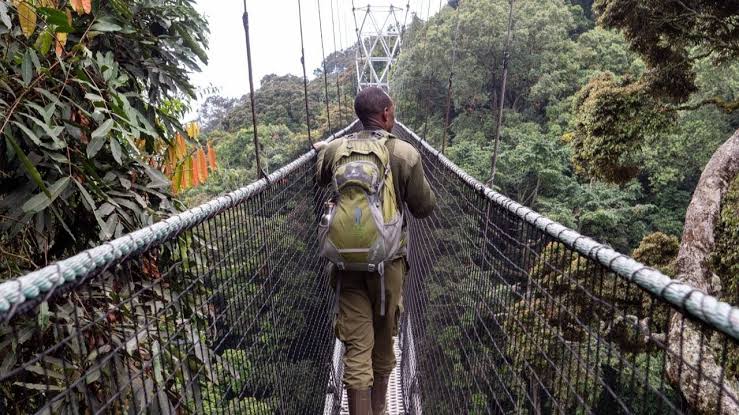
The canopy walk is one of Nyungwe’s best-known experiences.
It provides an elevated perspective over the forest and allows visitors to appreciate the scale of the landscape.
Although the canopy walk is not primarily a wildlife-tracking activity, birds and monkeys may sometimes be encountered.
The main attraction is the perspective.
Instead of seeing only trunks and understory vegetation, visitors gain views across treetops and surrounding hills.
It combines well with a guided forest walk.
Forest Trails
Nyungwe contains numerous walking routes of different lengths and difficulty levels.
Some trails focus on scenery, while others may pass through productive bird or primate habitat.
Routes can include ridges, streams, waterfalls and dense forest.
Visitors should select trails according to fitness and available time.
Trying to complete the longest route is not necessarily the best way to experience the forest.
A slower walk with an experienced naturalist can reveal far more wildlife.
Best Time for Nyungwe Wildlife Safaris
Nyungwe can be visited throughout the year.
Because it is a rainforest, visitors should expect moisture in all seasons.
Relatively drier periods generally provide easier trail conditions.
However, rain can still occur suddenly.
Wetter months produce lush vegetation and can be excellent for photography and certain aspects of birding.
Wildlife remains present year-round.
The best travel dates usually depend on the entire Rwanda itinerary.
What to Wear
Long trousers and long-sleeved shirts are recommended.
These provide protection from vegetation and insects.
Strong walking boots with good grip are essential because forest trails can become muddy and slippery.
A lightweight waterproof jacket should always be carried.
Gaiters may be useful during wet conditions.
Travelers should dress in layers because mornings can feel cool before temperatures rise during active walking.
Fitness Requirements
Fitness needs depend on the specific activity.
Chimpanzee trekking can involve substantial walking over steep terrain.
Other forest walks may be shorter and less demanding.
Visitors should discuss physical limitations with their safari planner before booking.
Porters may be available for certain activities and can provide valuable assistance with bags while supporting local livelihoods.
Regular walking preparation before travel can improve comfort.
Photography in Nyungwe
Forest photography can be challenging.
Light levels are often low, while primates may move quickly.
A camera capable of handling higher ISO settings can be useful.
A medium telephoto zoom is often more practical than very large equipment.
Visitors should protect cameras from humidity and rain.
Photographers also benefit from patience.
Waiting quietly can produce better opportunities than constantly moving through the forest.
Accommodation Near Nyungwe
Accommodation in the wider Nyungwe region ranges from comfortable lodges to high-end options.
Location is extremely important because many wildlife activities begin early.
Staying too far from the meeting point can require very early transfers.
Travelers should therefore choose accommodation based on the specific trekking activity rather than simply selecting the most attractive property.
Two or three nights is a useful minimum for most visitors.
How Many Days Do You Need?
Two nights allow a basic introduction.
Three nights are better for combining chimpanzee tracking with another forest activity.
Four nights may appeal to serious birders or primate enthusiasts.
A longer stay also provides flexibility if weather affects a planned activity.
Rushing through Nyungwe reduces the opportunity to appreciate the forest’s complexity.
Nyungwe and Volcanoes National Park
Nyungwe pairs naturally with Volcanoes National Park.
Nyungwe provides chimpanzees and numerous monkeys.
Volcanoes provides mountain gorillas and golden monkeys.
Travelers interested in primates can therefore build an itinerary focused almost entirely on different species and forest environments.
The two parks are geographically separate, so sufficient travel time should be included.
Nyungwe and Akagera
Adding Akagera creates a complete Rwanda wildlife safari.
Akagera contributes open savannah, elephants, giraffes, zebras, rhinos and predators.
Nyungwe introduces tropical forest and chimpanzees.
Volcanoes completes the journey with mountain gorillas.
A well-paced itinerary covering all three major parks generally deserves at least eight to ten days.
Combining Nyungwe with Uganda
Nyungwe can also be combined with Uganda.
Travelers may continue toward Uganda’s southwestern safari circuit and include Queen Elizabeth National Park, Bwindi Impenetrable National Park or Mgahinga.
Cross-border routes should be planned carefully around visas, transfer times and trekking permits.
For primate enthusiasts, combining Rwanda and Uganda creates an exceptional journey.
Why Choose Nyungwe Wildlife Safaris?
Nyungwe is ideal for travelers who appreciate forests, primates, birds and active exploration.
It is not a destination where dozens of large mammals appear beside a safari vehicle.
Its rewards are more intimate.
Hearing chimpanzees calling across a valley, watching monkeys move through the canopy or standing among ancient trees can be just as memorable as seeing a lion on open savannah.
Nyungwe wildlife safaris therefore add an essential forest component to a Rwanda journey. Combined with Akagera and Volcanoes National Park, Nyungwe helps create a safari spanning savannah wildlife, chimpanzees, mountain gorillas and some of East Africa’s most impressive rainforest landscapes.