
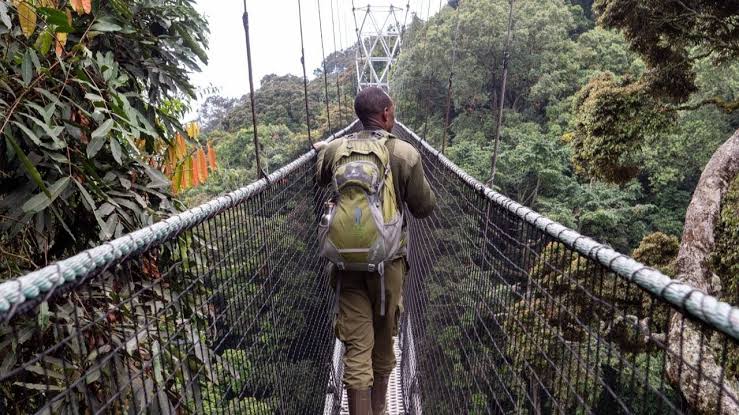
The forest supports an impressive diversity of birdlife, including species associated with montane habitats that are difficult to encounter elsewhere. For dedicated birdwatchers, Nyungwe is often an essential component of a Rwanda birding safari.
The destination is equally rewarding for general wildlife travelers. Visitors arriving primarily for chimpanzee trekking frequently discover that the forest’s birds become one of the unexpected highlights of their stay.
Nyungwe can be combined with Akagera National Park for savannah and wetland birds and Volcanoes National Park for highland birding and mountain gorillas, creating a remarkably varied Rwanda itinerary.
Why Is Nyungwe Important for Birding?
Nyungwe protects a large block of mature high-altitude forest.
Its terrain includes ridges, valleys, streams, bamboo areas, open edges and dense canopy.
Different bird species occupy different levels and habitats within this ecosystem.
Some remain high in the canopy, while others favor understory vegetation or forest edges.
The park’s position within the Albertine Rift gives it particular importance because several birds associated with this region have relatively restricted distributions.
Serious birders therefore visit Nyungwe not only to build a large species list but also to search for specialized forest birds.
What Is Forest Birding Like?
Forest birding is very different from birdwatching on open savannah.
In Akagera, birds may be visible from considerable distances.
In Nyungwe, vegetation frequently conceals them.
A bird may be calling only meters from the trail while remaining completely hidden.
Patience is therefore essential.
Visitors often spend significant periods listening, waiting and scanning a small section of vegetation.
When a difficult species finally appears, the sighting can be especially satisfying.
This slower style of birdwatching appeals strongly to experienced birders.
The Importance of Bird Calls
Bird calls are central to Nyungwe birding.
Experienced guides often identify a species by sound long before it is visible.
Different calls can reveal feeding flocks, territorial behavior or birds moving through the canopy.
Visitors unfamiliar with African forest birds can learn a great deal simply by listening to the guide.
Over several days, even beginners may begin recognizing some of the more distinctive calls.
Specialist birders should consider working with a guide whose knowledge extends beyond general forest interpretation.
Best Birding Habitats
Different parts of Nyungwe produce different birding opportunities.
Forest edges can provide clearer visibility than dense interior habitat.
Ridges may bring visitors closer to canopy-level species.
Streams and valleys support another collection of birds.
Bamboo and secondary vegetation can also be productive.
A good birding itinerary explores multiple environments rather than repeatedly visiting only one trail.
This increases the diversity of species likely to be encountered.
Mixed Bird Flocks
One of the most exciting forest birding experiences is encountering a mixed-species feeding flock.
Several bird species may move through the forest together while searching for food.
The activity can suddenly transform a quiet section of trail into an intense birding period.
Birders must work quickly because birds may continue moving through the vegetation.
Experienced guides help identify different species within the flock.
These encounters are one reason patience pays off in tropical forest birding.
Birding Early in the Morning
Early morning is generally one of the best times for birding.
Activity often increases around sunrise, and many birds vocalize during the first hours of daylight.
Temperatures are also more comfortable for walking.
Dedicated birders may begin very early and remain in productive habitat for several hours.
Morning mist can reduce visibility temporarily, but it also creates atmospheric forest conditions.
Bird activity can continue throughout the day, although midday periods may become quieter.
Afternoon Birding
Afternoon sessions can still be rewarding.
After quieter midday periods, bird activity may increase as temperatures fall.
A late-afternoon walk can also provide excellent light around forest edges.
Weather must be considered because afternoon showers are possible.
Travelers staying several nights can combine morning and afternoon sessions rather than relying on one birding period.
Best Time of Year for Nyungwe Birding
Birdwatching is possible throughout the year.
The best period depends partly on the species being targeted.
Seasonal rainfall influences breeding behavior, insect activity and forest conditions.
Wetter periods can produce excellent bird activity but more challenging trails.
Drier periods generally offer easier walking.
Specialist birders should discuss target species with an experienced guide before selecting travel dates.
General visitors can simply incorporate birding into the season chosen for their wider Rwanda safari.
Nyungwe Birding in the Wet Season
Rain brings increased insect activity and lush vegetation.
This can create excellent feeding conditions for many bird species.
The forest becomes exceptionally green, and streams flow strongly.
However, trails can become slippery and rain may interrupt observation.
Birders should carry waterproof equipment and remain flexible.
The rewards can be considerable for travelers who are comfortable in wet rainforest conditions.
Nyungwe Birding in the Dry Season
Relatively drier months often make hiking more comfortable.
Trails may still be damp because Nyungwe receives rainfall throughout the year.
Birds remain present, and experienced guides continue to locate productive areas.
The dry season is particularly convenient for travelers combining Nyungwe with Akagera game drives and gorilla trekking in Volcanoes National Park.
What to Wear for Birding
Long trousers and long-sleeved shirts are recommended.
Neutral colors work well in forest environments.
Strong walking boots with good grip are essential.
A waterproof jacket should always be carried.
A light fleece may be useful during cool early-morning starts.
Birders often spend long periods standing still, so clothing should remain comfortable even when not actively hiking.
Binoculars
Good binoculars are among the most important items for a Nyungwe birding safari.
Forest conditions can be dark, so binoculars that perform well in lower light are particularly useful.
Visitors should become familiar with their binoculars before traveling.
Birds may appear only briefly, and time lost adjusting equipment can mean missing a sighting.
A harness may be more comfortable than a neck strap during long days.
Bird Photography
Photography in Nyungwe can be technically demanding.
Light levels beneath the canopy are low, and birds may move quickly.
A telephoto lens capable of gathering reasonable light is useful.
Photographers should prepare for higher ISO settings.
Carrying excessive equipment can make long forest walks uncomfortable.
A versatile lens may therefore be more practical than several heavy lenses.
Rain protection is essential.
Primates While Birding
Birding walks can also produce primate encounters.
Nyungwe supports chimpanzees and several monkey species.
While a birding excursion is not a substitute for a dedicated chimpanzee trek, monkeys may appear in the canopy.
These encounters provide an added bonus.
Birders should remain alert to movement and calls that may indicate primates nearby.
Butterflies and Other Wildlife
The forest is rich in butterflies, insects and smaller wildlife.
Birders who move slowly often notice these species.
Butterflies can be particularly attractive around sunny clearings and damp areas.
Reptiles and amphibians may also appear.
This biodiversity means Nyungwe rewards anyone with broad natural-history interests.
Combining Birding with Chimpanzee Tracking
Chimpanzee tracking is one of the best additions to a Nyungwe birding itinerary.
Birders can dedicate one morning to chimpanzees and other days to specialist birding.
The chimpanzee trek itself may also produce bird sightings, although the pace is usually determined by the primates rather than birdwatching.
Three or four nights provide a good starting point for travelers combining both activities.
Combining Birding with Forest Walks
Scenic forest walks can introduce visitors to habitats different from those explored during dedicated birding sessions.
Waterfall trails, ridges and canopy experiences may all provide additional birding opportunities.
Travelers should tell their guide that birds remain a priority even on general nature walks.
This can encourage a slower pace and more frequent stops.
Nyungwe Birding and Akagera
Akagera National Park provides the perfect birding contrast.
Akagera’s lakes, wetlands, grasslands and woodland support species associated with much more open habitats.
A birding safari combining Nyungwe and Akagera can therefore build an exceptionally varied species list.
Travelers interested in both birds and mammals can also enjoy elephants, giraffes, zebras, hippos and predators while exploring Akagera.
Nyungwe Birding and Volcanoes National Park
Volcanoes National Park adds another highland habitat.
Visitors can combine birdwatching with mountain gorilla and golden monkey trekking.
The volcanic slopes, bamboo zones and montane vegetation provide a different birding environment from Nyungwe.
Together, the two parks demonstrate Rwanda’s remarkable highland biodiversity.
How Many Days for Nyungwe Birding?
General travelers may enjoy one dedicated birding walk.
Serious birdwatchers should consider at least three or four nights in the region.
Specialists pursuing particular species may want even longer.
Forest birding is unpredictable, and additional time provides opportunities to revisit areas when a target bird is missed.
A rushed itinerary is rarely ideal.
Private Birding Guides
Specialist birders should arrange a private or highly focused guide where possible.
A general safari group may not want to spend forty minutes trying to locate one bird hidden in dense vegetation.
A private birding arrangement allows the pace to reflect the visitor’s interests.
It also enables the guide to target species rather than simply following a standard nature trail.
Combining Nyungwe Birding with Uganda
Rwanda birding itineraries can be extended into Uganda.
Uganda offers several important forest and savannah birding destinations, including Bwindi, Semuliki, Queen Elizabeth and Mabamba.
Mabamba is particularly famous for shoebill viewing.
Bwindi combines exceptional forest birding with mountain gorilla trekking.
A cross-border birding safari can therefore provide extraordinary habitat diversity.
Why Choose Nyungwe for Birding?
Nyungwe birding rewards patience, careful listening and a willingness to explore slowly.
The forest does not reveal all of its birds immediately.
Instead, visitors gradually become aware of calls, movement and different layers of activity.
That challenge is exactly what makes the experience so rewarding.
Combined with chimpanzees, Akagera wildlife and Volcanoes mountain gorillas, Nyungwe adds one of Rwanda’s richest specialist nature experiences and is an essential destination for travelers who want to understand the country’s extraordinary biodiversity beyond its most famous mammals.