
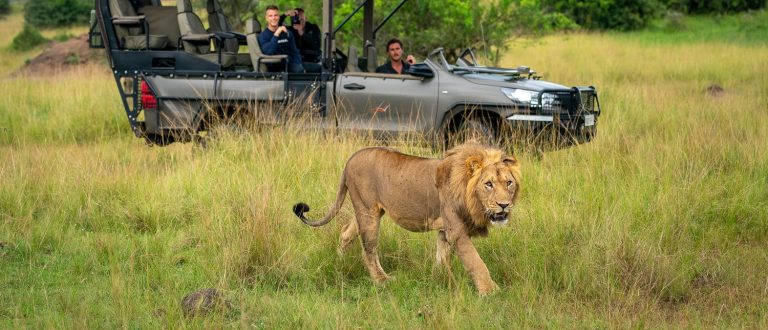
Located in eastern Rwanda, Akagera contains open grassland, woodland, rolling hills, wetlands and extensive lakes. These different habitats support an impressive range of wildlife and allow visitors to combine traditional game drives with boat safaris.
The park offers opportunities to see elephants, buffaloes, giraffes, zebras, hippos, crocodiles, antelopes and predators, while birdwatching adds another major attraction.
For travelers planning gorilla trekking, Akagera provides the perfect savannah complement.
Elephants in Akagera
Elephants are among the most impressive animals found in Akagera.
Their movements are influenced by water, food availability and seasonal conditions.
Visitors may encounter them feeding in woodland, moving across open areas or approaching water.
Family groups can provide fascinating observations.
Adult females may move together with younger animals while constantly communicating through body language and sound.
Seeing elephants behaving naturally is far more rewarding than simply obtaining a close photograph.
Guides therefore maintain respectful distances and allow animals to choose their own direction.
Buffaloes
African buffaloes are another prominent component of Akagera wildlife.
They may appear in different habitats and sometimes form substantial groups.
Buffaloes often feed on grasses and may gather near water.
Their size, heavy horns and unpredictable nature command respect.
From a safari vehicle, travelers can safely observe feeding, resting and herd behavior.
They also provide excellent photographic subjects, particularly when groups move across open landscapes.
Giraffes
Giraffes add unmistakable East African character to Akagera's savannah.
They can often be spotted above bushes or woodland vegetation because of their height.
Visitors may watch them browsing leaves or walking across open terrain.
Their slow, graceful movement makes giraffes particularly popular with photographers.
Morning and late-afternoon light can create memorable images, especially when distant hills form the background.
Zebras
Zebras are commonly associated with open grassland.
They may be encountered in groups grazing alongside other herbivores.
Their black-and-white patterns make them immediately recognizable and especially popular with younger safari travelers.
Guides can explain social behavior and the way zebras interact with grazing ecosystems.
Watching mixed groups of zebras and antelopes also shows how different species share the same habitat.
Antelopes
Akagera supports a variety of antelopes and other herbivores.
These species play an essential ecological role by converting grass and vegetation into food that supports predators.
For first-time visitors, different antelope species may initially look similar.
An experienced guide helps distinguish them through body size, horn shape, coloration and behavior.
Over several game drives, many travelers begin to appreciate these animals almost as much as the larger mammals.
Lions
Lions are among Akagera's most sought-after predators.
They may be difficult to locate during the hottest parts of the day because they frequently rest.
Morning and late afternoon can be productive periods to search.
Guides may examine tracks, recent sighting information and the reactions of prey species.
Finding lions is never guaranteed.
This uncertainty makes an actual sighting especially exciting.
Observing lions resting, walking or interacting naturally is one of the highlights of a Rwanda wildlife safari.
Leopards
Leopards are considerably more elusive.
These solitary cats are excellent at remaining concealed.
Woodland, bushes and tall grasses provide cover, and their spotted coats blend remarkably well with the environment.
Visitors fortunate enough to see a leopard often remember the encounter for years.
However, travelers should not measure the quality of their safari solely by whether this secretive predator appears.
Akagera contains enough wildlife diversity to remain rewarding even without a leopard sighting.
Rhinoceroses
Rhinos contribute significantly to Akagera's conservation importance.
Their presence is a reminder that wildlife tourism and conservation management are closely connected.
Rhinos require substantial protection because of threats that have affected populations across Africa.
Visitors should observe them only according to park regulations and guide instructions.
Close approaches should never be demanded for photography.
Responsible wildlife viewing helps protect both individual animals and the broader conservation program.
Hippos
Akagera's lakes and wetlands support hippos.
They spend much of the daytime in water and may be particularly well observed on a boat safari.
Visitors can watch hippos surfacing, interacting or resting in groups.
After dark they may leave the water to graze.
Their enormous size and powerful behavior make them fascinating but potentially dangerous animals.
Maintaining safe distances is essential.
Crocodiles
Crocodiles are another major component of Akagera's aquatic wildlife.
They may be seen along shorelines or moving through water.
Because they can remain almost completely still, spotting them often requires careful observation.
Boat guides know productive areas and help visitors distinguish crocodiles from logs or shoreline vegetation.
A boat safari therefore offers wildlife experiences that cannot easily be replicated during a game drive.
Warthogs and Smaller Mammals
Warthogs can frequently be encountered feeding in open areas.
Their characteristic habit of kneeling while grazing makes them entertaining to observe.
Other smaller mammals also inhabit Akagera.
Although visitors naturally concentrate on large animals, these species contribute to the ecological complexity of the park.
Taking time to notice tracks, burrows and smaller wildlife produces a much richer safari experience.
Primates
Akagera is principally a savannah wildlife destination rather than a specialist primate park.
Visitors interested primarily in chimpanzees or gorillas should combine Akagera with Rwanda's forest destinations.
Nyungwe is particularly famous for chimpanzee trekking, while Volcanoes National Park protects mountain gorillas and golden monkeys.
This distinction is useful when planning an itinerary.
Akagera provides the large-mammal experience, while Rwanda's forest parks add primates.
Birdlife in Akagera
Birds are an essential part of Akagera wildlife.
The park's habitat diversity supports savannah species, woodland birds, raptors and numerous water-associated species.
Wetlands and lakes can be especially productive.
A boat trip may reveal birds that are difficult to appreciate from safari roads.
Specialist birdwatchers should consider dedicating substantial time to the park and using an experienced guide.
Even visitors focused on mammals usually find themselves photographing and identifying birds as the safari progresses.
Best Areas for Wildlife
Wildlife distribution changes throughout the year.
Open plains may produce zebras, giraffes and antelopes.
Woodland can provide elephants and browsing species.
Lakes and wetlands support hippos, crocodiles and waterbirds.
Predators may move between habitats according to prey.
This means there is no single location that always contains the best wildlife.
Guides choose routes according to current conditions and recent sightings.
Morning Wildlife Viewing
Early morning is generally excellent.
Animals are active during cooler conditions, and predators may still be moving after nighttime activity.
Light is also ideal for photography.
Visitors should be ready for early departures.
A light jacket can be useful before the sun warms the savannah.
Morning drives are especially worthwhile for travelers hoping to locate predators.
Afternoon Wildlife Viewing
Late afternoon provides another excellent period.
Herbivores become more active as temperatures fall.
Predators may begin to move.
The landscape also becomes highly photogenic as warm light spreads across hills and grasslands.
Travelers staying for several nights should experience both periods rather than relying on a single game drive.
Boat Safari Wildlife
Boat safaris reveal another part of Akagera's biodiversity.
Hippos and crocodiles are the obvious attractions, but shorelines can also attract mammals coming to drink.
Waterbirds provide continuous interest.
For many visitors, the contrast between game drives and boating becomes one of the strongest aspects of the park.
Best Time to See Akagera Wildlife
Wildlife can be seen throughout the year.
Drier months often provide easier visibility because vegetation becomes less dense and animals may gather around permanent water.
The greener seasons create lush scenery and can be excellent for birdwatching and photography.
Rainfall influences road conditions but does not remove wildlife from the park.
Travelers should select dates according to the wider Rwanda itinerary.
Photography
Akagera is highly rewarding for wildlife photography.
A versatile telephoto zoom is particularly useful because animals may appear at varying distances.
Photographers should also capture landscapes.
The combination of hills, wetlands and open savannah distinguishes Akagera from many flatter wildlife areas.
Private vehicles provide greater flexibility because photographers can remain longer at productive sightings.
Akagera Wildlife and Gorilla Trekking
Akagera pairs perfectly with mountain gorilla trekking in Volcanoes National Park.
Travelers can begin with savannah wildlife and then move into the volcanic highlands.
One day may involve elephants, zebras and lions; a few days later the traveler may be hiking through dense forest in search of mountain gorillas.
This dramatic change of environment makes Rwanda exceptionally rewarding.
Akagera Wildlife and Chimpanzees
Nyungwe can add chimpanzees to the itinerary.
Combining all three parks produces a complete wildlife journey.
Akagera contributes large mammals and wetlands.
Nyungwe contributes chimpanzees and montane rainforest.
Volcanoes contributes gorillas and golden monkeys.
Travelers with adequate time should consider at least eight to ten days for a comfortable version of this route.
Why Akagera Wildlife Matters
Akagera demonstrates that Rwanda's natural heritage extends far beyond gorillas.
Its elephants, buffaloes, predators, giraffes, rhinos, zebras, hippos and birds form part of a restored and protected ecosystem that provides one of East Africa's most rewarding compact safari experiences.
For travelers already visiting Rwanda for primates, Akagera wildlife adds an entirely new dimension.
The ability to combine savannah game viewing, water-based wildlife, chimpanzees and mountain gorillas within one journey makes Rwanda a surprisingly complete safari destination.