
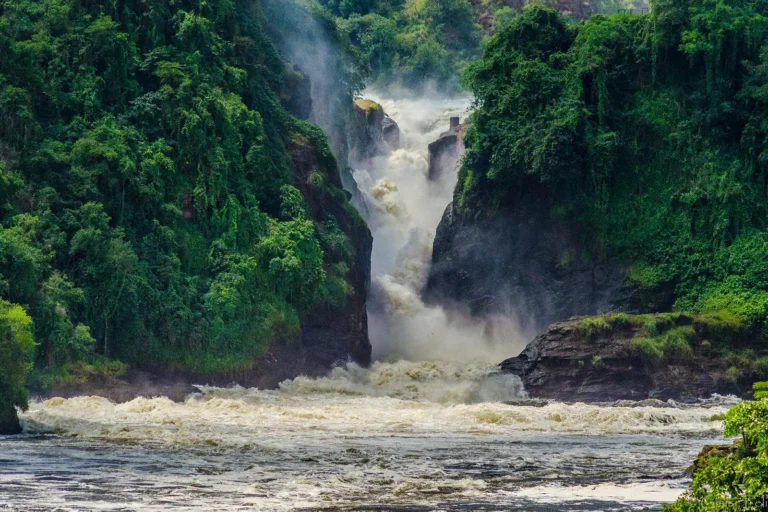
The diversity of Murchison Falls wildlife makes Murchison Falls National Park one of Uganda’s most rewarding safari destinations. Its combination of open savannah, woodland, riverine habitat and the Nile supports a rich range of mammals, birds and reptiles, including giraffes, elephants, buffalo, lions, hippos and Nile crocodiles.
The park is particularly attractive because wildlife can be experienced from both land and water. Morning game drives explore the savannah, while boat safaris reveal animals gathering along the Nile. The dramatic Murchison Falls itself adds a major landscape experience.
The wider conservation region can also be combined with chimpanzee trekking in Budongo Forest, giving visitors the opportunity to include primates alongside traditional big-game viewing.
What Wildlife Can You See in Murchison Falls?
Visitors can encounter a broad range of mammals.
Commonly sought species include African elephants, Rothschild's giraffes, African buffalo, Uganda kob, hartebeest, waterbuck and warthogs.
Predators include lions and leopards, while hyenas and smaller carnivores also form part of the ecosystem.
The Nile supports enormous numbers of hippos and provides habitat for Nile crocodiles.
Birdlife is equally important and adds significant variety to every safari activity.
Giraffes
Giraffes are among the most distinctive examples of Murchison Falls wildlife.
The park's open northern landscapes provide ideal conditions for seeing these tall animals moving between woodland and savannah.
Visitors may encounter individuals or loose groups feeding on trees.
Their height makes them relatively easy to spot, and they are excellent photographic subjects.
Wide landscape images can be particularly attractive because the giraffes help demonstrate the scale of the park's open plains.
African Elephants
Elephants occur throughout suitable areas of Murchison Falls National Park.
They may be encountered feeding in woodland, crossing open terrain or moving toward the Nile.
Family groups provide opportunities to observe social behavior, especially interactions between calves and adults.
Large bulls may also be seen alone.
Visitors should always respect the distance recommended by their guide.
Elephants are intelligent, powerful wild animals and should never be pressured by safari vehicles.
African Buffalo
Buffalo are another important large mammal.
They may occur in substantial herds across the savannah or in smaller groups.
Animals may also approach the Nile, creating opportunities for boat-based sightings.
Buffalo are powerful and potentially unpredictable.
A professional guide understands their behavior and positions the vehicle safely.
Lions
Lions are among the most exciting predators found in the park.
Game drives often include a deliberate search for prides or individual lions.
Early mornings can be particularly productive because temperatures are cooler and lions may still be active.
However, sightings cannot be guaranteed.
Even large lions can disappear remarkably well into grass.
Guides use experience, recent reports and animal behavior to improve the search.
Leopards
Leopards occur within the Murchison ecosystem but are naturally harder to find.
Their solitary behavior and camouflage make every sighting special.
A leopard might be encountered crossing a track, resting in vegetation or occasionally in a tree.
Visitors should remain patient and avoid assuming every game drive will produce one.
The rarity of the encounter is precisely what makes it memorable.
Hyenas
Hyenas are important predators and scavengers within the ecosystem.
They are highly social and play a significant ecological role.
Travelers may occasionally see them during game drives or hear their calls around wildlife areas after dark.
Their reputation is often shaped by myths, but guides can explain their complex behavior and contribution to the park.
Uganda Kob
Uganda kob are characteristic antelopes of many Ugandan savannah landscapes.
They are an important prey species for predators and can often be seen in suitable open areas.
Visitors may observe males displaying territorial behavior or groups grazing together.
Learning about species such as kob makes the safari more interesting than concentrating only on big cats.
Hartebeest
Hartebeest are another distinctive savannah herbivore.
Their elongated faces and sloping backs make them relatively easy to identify.
They can be seen feeding across open grassland and are well adapted to the park's landscapes.
Like other antelopes, they form an important part of the prey base supporting predators.
Waterbuck
Waterbuck commonly use grassland and areas relatively close to water.
Their sturdy build and distinctive markings make them recognizable during game drives.
Guides can help visitors distinguish them from other antelope species.
Warthogs
Warthogs are frequently encountered on safari.
They may graze in open areas, sometimes kneeling on their front legs while feeding.
When alarmed, they often run quickly with their tails held upright.
They are especially popular with families and younger travelers but also play an important role in the savannah ecosystem.
Hippos
Hippos are one of the major attractions of the Nile.
A boat safari provides an excellent opportunity to observe them in the water.
Groups may be seen resting, surfacing and interacting.
Although they appear calm, hippos are among Africa's most powerful large mammals.
Viewing should always take place at a safe distance under the direction of the boat crew.
Nile Crocodiles
The Nile supports impressive crocodiles.
Visitors may see them resting on banks or floating partially submerged.
Their camouflage often makes them difficult to spot until a guide points them out.
Large crocodiles are particularly impressive from the boat, where the low viewing perspective emphasizes their size.
Primates in the Wider Murchison Region
The broader Murchison Falls Conservation Area can be combined with Budongo Forest, which supports chimpanzees and several other primates.
This means travelers can include an active forest-based primate experience alongside traditional savannah wildlife.
Budongo chimpanzee trekking is especially useful for visitors who want chimpanzees but are already focusing on northern Uganda.
Birds
Birdlife is an essential part of Murchison Falls wildlife.
The variety of habitats supports raptors, savannah birds, wetland species and river-associated birds.
Boat safaris are particularly good for kingfishers, herons, egrets and other waterbirds.
Game drives add species found in grassland and woodland.
Even travelers who are not dedicated birdwatchers should bring binoculars.
Wildlife on Game Drives
Game drives focus mainly on the terrestrial mammals of the savannah.
Morning drives often provide excellent opportunities because cooler temperatures encourage more animal activity.
Late afternoon can also be rewarding.
The route changes according to recent sightings, road conditions and traveler interests.
Private safaris provide the flexibility to spend more time at a particularly good wildlife encounter.
Wildlife on the Nile Boat Safari
The boat safari provides a completely different perspective.
Hippos and crocodiles become major attractions, while elephants, buffalo and antelopes may appear along the shoreline.
Birdlife is exceptionally rich.
The slower pace allows travelers to observe behavior rather than continually moving between sightings.
Combining the boat and game drive produces a much more complete safari.
Best Time to See Murchison Falls Wildlife
Wildlife viewing is possible throughout the year.
Relatively drier periods often provide easier road conditions and can make animals more visible as vegetation becomes less dense.
Water sources may also attract wildlife.
Wetter periods produce greener scenery and can be rewarding for birding.
No season guarantees particular predators.
The quality of a safari depends heavily on guide experience, patience and natural wildlife movement.
Best Time of Day
Early morning and late afternoon are generally excellent for terrestrial wildlife.
Predators and herbivores can be more active while temperatures are cooler.
Midday is well suited to river activities, lodge relaxation or waterfall visits.
A well-designed itinerary uses different parts of the day for different safari experiences.
Photography
Murchison Falls offers excellent wildlife photography.
Giraffes and elephants work particularly well in broad landscape compositions.
Predators often require longer lenses.
Boat safaris create lower viewing angles for hippos, crocodiles and birds.
Photographers should be prepared for dust, sunlight and occasional rain and should carry spare batteries.
Wildlife for Families
The park is suitable for families because most wildlife activities take place from vehicles or boats.
Children can see large mammals without completing strenuous hikes.
Parents should consider game-drive length and build in breaks.
A private safari vehicle provides the greatest flexibility.
Wildlife for Birdwatchers
Serious birdwatchers may want several days in the park.
Different habitats can be explored at different times of day.
The Nile adds valuable wetland and riverine species to the savannah bird list.
Budongo Forest can also be added for additional forest birds.
Wildlife and Budongo Chimpanzees
Combining Murchison Falls with Budongo creates a particularly diverse safari.
Visitors can search for chimpanzees on foot in tropical forest and then enjoy giraffes, elephants and lions from a vehicle.
A Nile boat safari adds a third style of wildlife viewing.
This variety is difficult to achieve in many other short safari itineraries.
Conservation and Responsible Wildlife Viewing
The long-term survival of Murchison Falls wildlife depends on healthy habitats and responsible conservation.
Visitors should respect park rules, maintain appropriate distances and avoid pressuring guides to approach wildlife too closely.
Off-road driving should only occur where specifically permitted.
Responsible tourism helps ensure wildlife remains wild and habitats remain protected.
Plan Your Murchison Falls Wildlife Safari
The diversity of Murchison Falls wildlife makes the park one of the strongest destinations for a complete Uganda safari experience.
We can arrange private game drives, Nile boat safaris, accommodation and waterfall visits while incorporating Budongo chimpanzee trekking for travelers interested in primates.
Murchison Falls can also be connected with Kibale, Queen Elizabeth National Park and Bwindi, creating a longer itinerary featuring savannah wildlife, river species, chimpanzees and mountain gorillas.