
Introduction
This diversity makes Bwindi particularly important for naturalists and travelers building a broader primate-focused safari through Uganda.
Why Bwindi Is Important for Primates
Bwindi protects a large block of montane and lowland forest in southwestern Uganda. The park’s steep valleys, ridges and varied elevation create multiple habitats suitable for different primates. These animals use the forest in different ways.
Some spend much of their time on the ground. Others remain primarily in trees. Some feed heavily on leaves, while others depend on fruits, insects or a mixed diet. This variety demonstrates the ecological complexity of the forest.
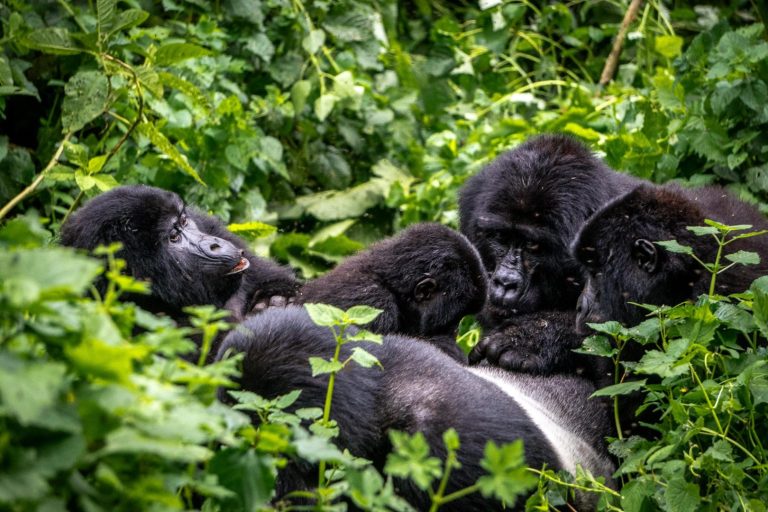
Mountain Gorillas
Mountain gorillas are the best-known of all Bwindi primates. They are large, ground-dwelling apes that live in stable social groups led by mature silverbacks. A typical gorilla family may contain:
- one or more silverbacks
- adult females
- younger males
- juveniles; and - infants
The social behavior of gorillas is one of the most fascinating parts of trekking. Visitors may watch adults feeding while juveniles play nearby or see a silverback monitoring interactions within the group. The experience often feels surprisingly intimate because many gorilla behaviors appear recognisably social.
Gorilla Trekking as a Primate Experience
Gorilla trekking is not simply about seeing a large ape. It provides insight into primate behavior and forest ecology. During the encounter, guides may explain:
- family structure
- feeding habits
- communication
- movement
- conservation challenges; and - the habituation process
Travelers interested in primatology should listen carefully rather than focusing only on photography. The educational aspect can make the experience significantly more meaningful.
Chimpanzees in Bwindi
Chimpanzees occur within the Bwindi ecosystem, although the park is not Uganda’s main destination for organised chimpanzee trekking. Chimpanzees are often more arboreal and mobile than mountain gorillas.
Colobus Monkeys
Colobus monkeys are among the visually distinctive primates associated with forest habitats in Uganda. They are highly arboreal and may move through the canopy in groups. Their long limbs and specialised digestive systems allow them to exploit leafy forest diets.
Spotting colobus monkeys often requires looking upward rather than concentrating on the trail. Binoculars can help considerably.
L’Hoest’s Monkeys
L’Hoest’s monkeys are associated with montane forest environments in the Albertine Rift region. They are an exciting sighting for primate enthusiasts because their distribution is much more limited than some widespread African monkey species.
Blue Monkeys
Blue monkeys occur in a number of East and Central African forest environments. They spend much of their time in trees and can sometimes be seen moving through the canopy. Their dark coloration and forest setting can make them difficult to detect.
Listening for movement in branches or calls can help guides locate them.
Red-Tailed Monkeys
Red-tailed monkeys are another forest primate visitors may encounter. They are generally agile, active and highly arboreal. The distinctive reddish coloration around parts of the tail and body can help with identification when views are clear.
Like many forest monkeys, they can disappear rapidly through vegetation.
Olive Baboons
Olive baboons occur in many parts of Uganda and may be encountered in more open habitats and along roads around protected areas. They differ from Bwindi’s more forest-dependent primates because they can adapt to a wider range of environments. Baboons live in complex social groups and are highly intelligent.
Visitors should never feed them because food conditioning can alter natural behavior and create conflict.
Nocturnal Primates
Bwindi and the surrounding region also support smaller nocturnal primates. These animals are much harder for ordinary safari visitors to observe because they are active at night and often remain concealed in dense vegetation. Their presence adds another layer to the park’s primate diversity.
Specialised research and guided night experiences in appropriate areas may reveal species that daytime travelers never see.
How to See Primates in Bwindi
Gorilla Trekking
This is the most reliable primate experience in the park. Visitors track a designated habituated gorilla family under ranger supervision.
Guided Forest Walks
Forest walks provide opportunities to detect monkeys and other primates outside the main gorilla trekking experience.
Birdwatching Excursions
Birding can unexpectedly produce excellent primate sightings because birders spend long periods scanning the canopy.
Lodge Observation
Some lodges near the forest receive visits from monkeys moving through surrounding trees. Guests should keep binoculars nearby, particularly in the morning.
Best Time for Primate Viewing
Bwindi can be visited throughout the year. Gorilla trekking operates year-round. For general primate viewing, the main seasonal differences involve:
- rainfall
- trail conditions
- food availability
- forest visibility; and - overall visitor comfort
Relatively drier months can make walking easier. Wetter months create lush vegetation but may reduce visibility in some situations. Primates remain in the forest regardless of tourist season.
Primates and Forest Canopy
One challenge of primate viewing is that many species spend much of their time above ground. A monkey may be only 30 meters away but remain almost invisible behind leaves. Good binoculars are therefore strongly recommended.
A lightweight pair is easier to carry during long walks than heavy specialist equipment. Visitors should also learn to pause and listen. Falling leaves, snapping branches and vocalisations can reveal animals that cannot yet be seen.
Primate Photography
Photographing monkeys in Bwindi can be more difficult than photographing gorillas. Monkeys tend to:
- move rapidly
- stay high in the canopy
- pass behind leaves
- appear against bright sky; and - remain in low forest light
A camera with fast autofocus and good high-ISO performance is useful. A moderate telephoto lens can help, but weight should always be considered if you are walking for several hours.
Combining Bwindi With Kibale National Park
For serious primate enthusiasts, one of Uganda’s best itineraries is: Entebbe → Kibale National Park → Queen Elizabeth National Park → Bwindi Impenetrable National Park → Entebbe Kibale is famous for chimpanzee trekking and supports an impressive range of monkeys.
Combining Bwindi With Mgahinga
Travelers spending more time in southwestern Uganda can also combine Bwindi with Mgahinga Gorilla National Park.
This combination is particularly attractive for travelers whose primary interest is primates rather than classic savannah wildlife.
Golden Monkeys and Bwindi
Golden monkeys are strongly associated with the Virunga region rather than Bwindi itself. Travelers wanting to see them should consider adding Mgahinga Gorilla National Park. A southwestern Uganda primate itinerary can therefore include:
Why Primates Matter to Bwindi Conservation
Primates are important components of forest ecosystems. By feeding on fruits, leaves and other vegetation, they influence:
- seed dispersal
- forest regeneration
- food webs; and - plant distribution
Responsible Primate Viewing
Visitors should behave responsibly around all primates, not just gorillas. Important principles include:
- never feed wildlife
- keep appropriate distance
- follow guide instructions
- avoid loud noise
- do not chase animals for photographs
- avoid leaving food unattended; and - respect health precautions
Feeding monkeys can make them dependent on humans and increase conflict around lodges and roads.
How Many Days for a Primate-Focused Bwindi Visit?
A standard gorilla traveler may spend two nights. Primate enthusiasts should consider at least three nights. A longer stay can include:
Frequently Asked Questions
What is the most famous primate in Bwindi?
The mountain gorilla is by far the park’s most famous primate.
Are there chimpanzees in Bwindi?
Yes, chimpanzees occur in the ecosystem, although Bwindi is not the principal destination for organised chimpanzee trekking.
Where should I go for chimpanzee trekking?
Kibale National Park is Uganda’s leading destination for chimpanzee trekking.
Are there monkeys in Bwindi?
Yes. Bwindi supports several monkey species associated with forest habitats.
Can I see primates while gorilla trekking?
Possibly. Other primates may be encountered along the route, but the trek’s main objective is the assigned gorilla family.
Should I carry binoculars?
Yes. Binoculars are especially useful for monkeys moving through the canopy.
Discovering Bwindi Primates Beyond the Gorillas
Mountain gorillas understandably dominate tourism in Bwindi, but focusing only on them can obscure the wider primate richness of the forest. The diversity of Bwindi primates includes apes and monkeys adapted to different parts of the ecosystem.
This creates an exceptional opportunity to understand primates not as isolated safari attractions, but as different species occupying interconnected forest ecosystems across southwestern Uganda.